
Solomon II, 9 - from the portfolio The Song of Songs Which is Solomon's by Paul Wunderlich
Solomon II, 9 - from the portfolio The Song of Songs Which is Solomon's
Paul Wunderlich
Solomon II, 9 - from the portfolio The Song of Songs Which is Solomon's
Paul Wunderlich
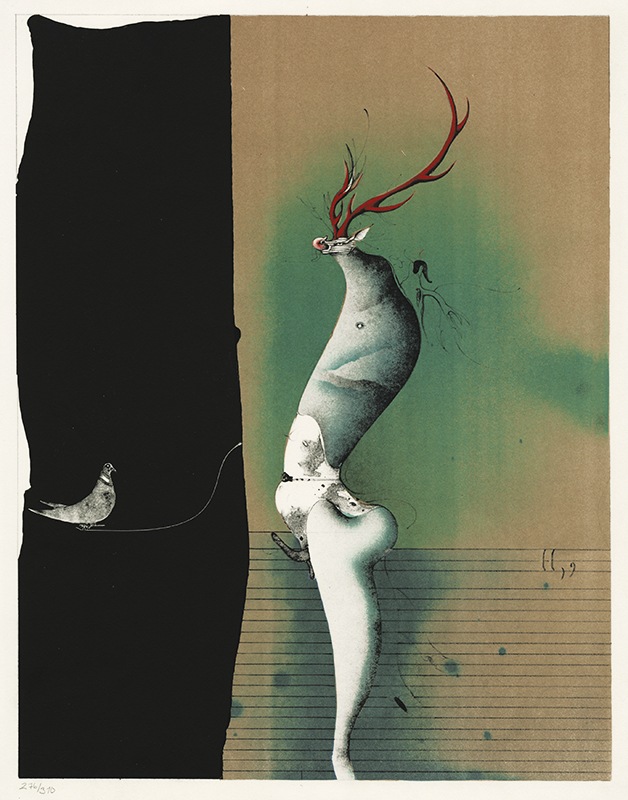
1927 - 2010 (biography)From a portfolio of ten color lithographs illustrating the erotic poem found in the Hebrew Bible and the Old Testament, the "Song of Songs." This image is for verse IV, 9: "My beloved is like a gazelle or a young stag. / Look! There he stands behind our wall, / gazing through the windows, / peering through the lattice." (New International Version)
Though traditionally attributed to King Solomon, historians debate Song of Songs' origins as being anywhere between the 10th and 2nd centuries BCE. It is interpreted by Abrahamic religions as an allegory of the relationship between God and Church. Stylistically, however, its roots are most similar to the love songs of ancient Egypt and erotic Sumerian sacred marriage hymns. Therefor its inclusion in the Bible is somewhat anomalous, bearing no theological or moralistic purpose. Some historians outwardly reject the divine interpretation, and consider it an explicitly human poem, meant to celebrate the universal connection between mutual love and sexual desire. In its simplest interpretation, Song of Songs tells the story of two lovers expressing their admiration and desire for one another.
Wunderlich's visual interpretation of the Song of Songs allows for these historical complexities. Done in his signature Surrealist style, with soft, rounded forms floating through stark landscapes, there is no focus on analogy or metaphor. Instead, each image stands alone in a stark, dream-like testimony to the passage it is illustrating.