
19th, 20th & 21st Century Fine Prints
707-546-7352 · fax 707-546-7924 · web: www.annexgalleries.com · email: artannex@aol.com
Untitled abstraction by Robert Rauschenberg
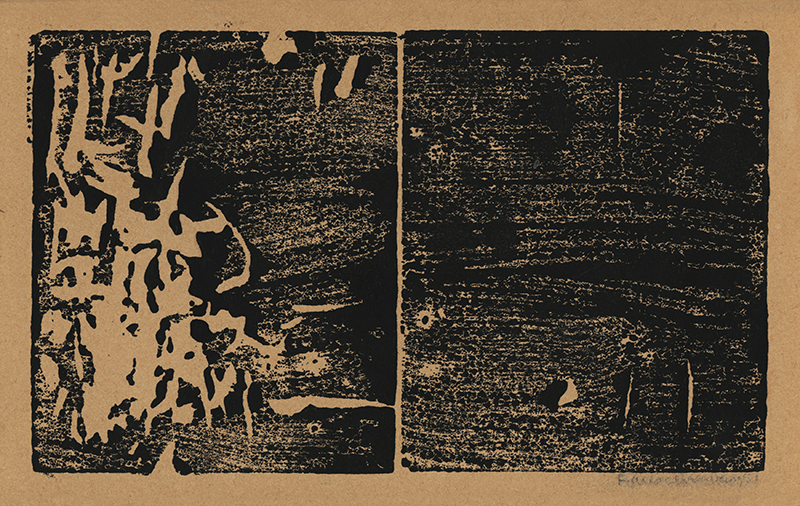
Untitled abstraction
Robert Rauschenberg
Untitled abstraction
Robert Rauschenberg
1925 - 2008 (biography)1951 was a seminal year for Robert Rauschenberg, in which he created his White Paintings series, was commissioned to create his "blueprint" works for Bonwit Teller and Tiffany & Co., and began collaborating with artists of other disciplines, including composer John Cage. His studies at Black Mountain College were in their fourth year and he was pursuing painting, photography, collage, and printmaking - an endeavor that was first guided by Josef Albers in a contentious but important working relationship.
Though he would later become known more for his colorful photo-transfer prints than for his Abstract Expressionist prints, his time at Black Mountain College (1948 - 1953) spurred a lengthy engagement with stripped down, monochromatic imagery across several mediums, inspired by the Abstract Expressionism born in the mid 1940s. Grids, black or white color fields, and the interplay of light and shadow culminated in principles that he would retain throughout his career.
His first woodcut titled, "This is the First Half of a Print Designed to Exist in Passing Time" (1948-'49) was in itself an epic introductory work, a hand-bound "flip book" executed in black and white. The untitled print shown here came four years later and retains the minimalist sensibility that he had been immersed in since his arrival at the school. He uses the grain of the wood to communicate movement, and a concentration of negative-space gouges in the left half of the grid appears to be a cluster of energy, ready to disperse.
This impression is from the estate of Carroll Williams who taught printing at Black Mountain College, working with Buckminster Fuller, Rauschenberg, et al. and then from the estate of San Francisco AbEx print collector Marian Schell.