
Picnic (also called: "The Blanches and the Lees") by Pele de Lappe
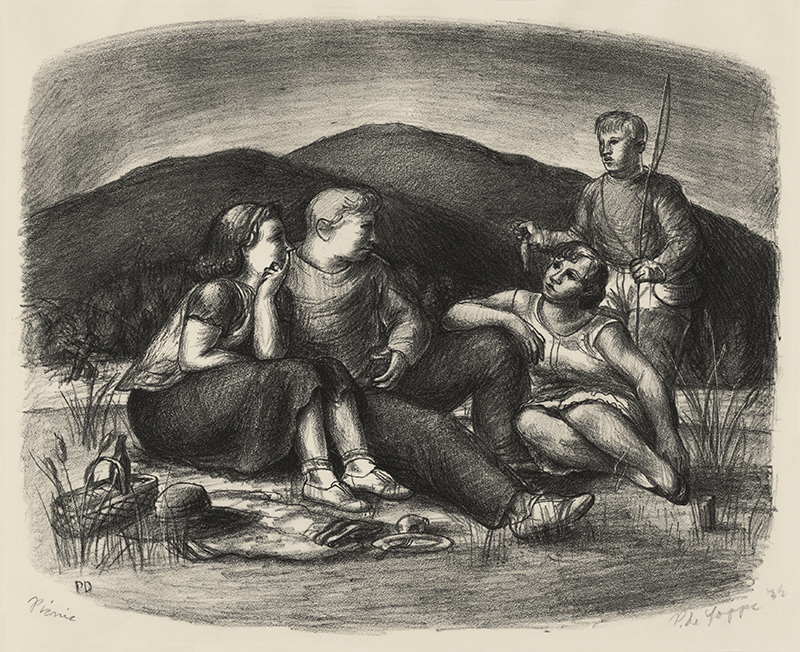
Picnic (also called: "The Blanches and the Lees")
Pele de Lappe
Picnic (also called: "The Blanches and the Lees")
Pele de Lappe
1916 - 2007 (biography)According to the New York State Museum, this is a summertime image. The subjects are two Woodstock couples, Lucille and Arnold Blanch on the left, and Doris and Russell Lee on the right. Doris Lee drapes her arm over Arnold Blanch’s knee, gazing at him. Both couples eventually divorced and, Doris and Arnold, who would have been one of her teachers, married in 1939.
This lithograph is illustrated in “The Historic Woodstock Art Colony: Arthur A. Anderson Collection.” which notes: "Long before the famous music festival in 1969, Woodstock, New York, was home to what is considered America’s first intentionally created, year-round arts colony—founded in 1902 and still thriving over 100 years later. Collecting the remarkable range of work produced there has been Arthur A. Anderson’s focus for three decades, resulting in the largest comprehensive assemblage of its type. The artists represented in it reflect the diversity of those who came to Woodstock, including Birge Harrison, Konrad Cramer, George Bellows, Eugene Speicher, Peggy Bacon, Rolph Scarlett, and Yasuo Kuniyoshi, among many others.
Anderson recently donated his entire collection—some 1,500 objects by almost 200 artists—to the New York State Museum, located in Albany, NY.
Phyllis (Pele) deLappe, artist, labor cartoonist, and social activist was born in San Francisco, California on May 4, 1916. Versed by her father, the commercial artist Wes de Lappe, in Marxism and life studies (caricatures), she began her art studies at California School of Fine Arts in 1930 under Arnold Blanch. The following year, at the age of fifteen, de Lappe moved to Woodstock, New York where she lived with Arnold and Lucile Blanch. She enrolled in the Art Students’ League in 1932 where she studied with Edward Lansing, Kenneth Hayes Miller, John Sloan and Charles Locke. She learned the technique of lithography from Adolf Dehn. De Lappe found inspiration in the night life of the east coast, going to dance marathons in New Jersey and the nightclubs of Harlem, often sketching the people she met. At this time De Lappe also worked with Mexican artist David Siqueiros, and modeled for and assisted Diego Rivera on the Rockefeller Center murals in New York.
Returning to San Francisco in 1934, Pele found herself in the midst of the maritime strike. She got involved by joining the Marine Workers Industrial Union Ladies Auxiliary, walking the picket lines, raising money for the strikers and drawing cartoons for the union newsletter. The year 1935 was life changing as she married Bertram Edises, a civil rights attorney, and her first solo exhibition was mounted at the Art Center Gallery in San Francisco. The couple relocated to Washington, D.C. in 1937 but returned to San Francisco in 1941.
DeLappe’s work focused on the working class and she made a meager living by drawing for the Daily Worker, New Masses, L'Unita Operaia, West Oakland Beacon, and the San Francisco Chronicle. During the 1940s de Lappe was a feature editor and cartoonist for The People’s World and in 1952 she helped to found the Graphic Arts Workshop in San Francisco.
A resident of Berkeley, California for many years, de Lappe moved north to Petaluma in the 1990s at the encouragement of her friend and fellow artist, Byron Randall. During the next few years she penned her autobiography, Pele: A Passionate Journey through Art and the Red Press. Her work is included in the collections of the Achenbach Foundation for the Graphic Arts, Syracuse University, Woodstock Art Association and the Library of Congress.
Phyllis "Pele" deLappe died in Petaluma, California on October 10, 2007.