
Gordo (original comic strip featuring Pepito and Mary Frances) by Gus Arriola
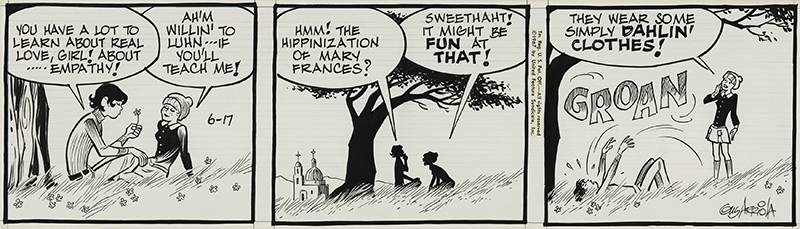
Gordo (original comic strip featuring Pepito and Mary Frances)
Gus Arriola
Gordo (original comic strip featuring Pepito and Mary Frances)
Gus Arriola
1917 - 2008 (biography)Gus Arriola is noted as one of the first American comic strip artists to feature and humanize his Mexican-American culture. Having grown up in a Spanish-speaking household in Arizona, the comic strip acted as a reflection of his unique view of the American politics and social changes from 1941 to 1985. Upon Arriola's retirement, Gordo would be one of the longest running strips to be penned by the original artist, surpassed later only by Charles Schultz.
Through the humorous reworking of racial tropes and his bold, often colorful style, Arriola's Gordo strip empahsized the everyday lives of characters Gordo Salazar Lopez, a Mexcian farmer and tour guide; his nephew Pepito, who grows up to become a classic 1960s hipster, and his distinctly Texan WASP friend Mary Francis, based on Arriola's wife of the same name; Tehuana Mama, Gordo's strict but loving housekeeper; the beautiful and scheming Widow Gonzalez, and a cadre of animals and insects (including the Beatnik spider Bug Rogers), among many others.
Gus Arriola's legacy is summarized by famed San Francisco Chronicle columnist Herb Caen, who wrote: "We all need families, our own and at least one other...For more years than I care to think about, my other family has been the singular creation of Gus Arriola—Senor Gordo and his extended menagerie of diverting humans and spectacular animals. Haven't we all wanted to live as Gordo does? One can only envy him his charmed life: the perfect village, the adorable senoritas, the easily survivable hangovers and heartbreaks, and the marvelous array of animals that give the comic strip—a term that seems inadequate—its several dimensions.
"Gus's are real people," Caen continued, "the kind one can easily and happily live with for a quarter of a century. I know, because I have done it. As for Gordo himself, he is a literary contrivance of the first magnitude—buffoon as hero, great lover manque, a pen-and-ink Everyman whose triumphs and tragedies are our own. Long may he and his flock survive. Breakfast without them would be unthinkable."
An in-depth essay on Arriola's life and contribution to comics can be found on the website of cartoonist R.C. Harvey (rcharvey.com/gusobit.html).