
Reconnaissance par le Porcher - Pl. VIII from the "L'Odyssee" portfolio by Andre Masson
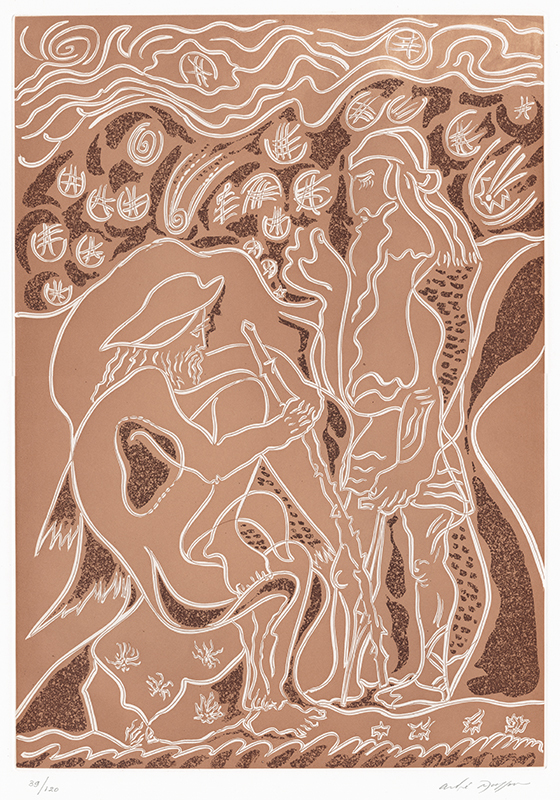
Reconnaissance par le Porcher - Pl. VIII from the "L'Odyssee" portfolio
Andre Masson
Reconnaissance par le Porcher - Pl. VIII from the "L'Odyssee" portfolio
Andre Masson
1896 - 1987 (biography)Disguised as a beggar, Odysseus returns home to Ithaca and, at once, seeks out his faithful swineherd, Eumaeus, who offers the stranger nourishment. After a twenty-year absence, Odysseus is not recognized by the swineherd until he exposes a scar on his leg as identification. Eumaeus acknowledges his master and warns him of the dangerous suitors living in his palace, pursuing his wife Penelope, and pillaging the land. Odysseus and Eumaeus go to the palace where they are joined by Telemachus, son of Odysseus, and together they slay the suitors and the maids that laid with them.
In his image, Masson depicts Eumaeus seated causally with staff in hand in front of a standing beggar. His eyes are cast downward as if he is judging the man and the story being told him. In moments, Odysseus will identify himself and the demeanor of Eumaeus will change as he recognizes and welcomes his king.
Andre Masson moved to Paris in 1912 to study at the École nationale supérieure des beaux-arts. While in Paris, he became interested in mythological-themed paintings of Nicolas Poussin, subjects that he would later investigate in his own work. In 1915 he joined the French infantry and fought in the battles of the Somme. He was seriously wounded during a battle in 1917 and spent months in the hospital recovering physically and psychologically. The war influenced Masson's art and he later wrote, "The field of battle made a human being of me. It literally threw me into the humus humain."
In 1919, he moved to the south of France for a few years before returning to Paris. There he participated in the Surrealist movement between 1924 and 1929 and became a leading practitioner of automatism. Masson's work was declared degenerate under the German occupation of France during World War II. He fled France eventually taking refuge in United States, first living in New York before moving to rural Connecticut in 1941. It was during this time that he worked at Stanley William Hayter's experimental workshop Atelier 17 at the New School in New York.
Masson returned to France in 1945 and settled in Aix-en-Provence in 1947. He was awarded the Grand Prix National des Art in 1954 and, in 1958, the Venice Biennale dedicated an entire room to his work. As early as 1933 he produced designs for the stage and, in 1965, he was invited to paint the ceiling of the Théâtre de l'Odéon in Paris.
Andre Masson died on 28 October 28 1987 in Aix-en-Provence, France.