
Rampart by Jacob Kainen
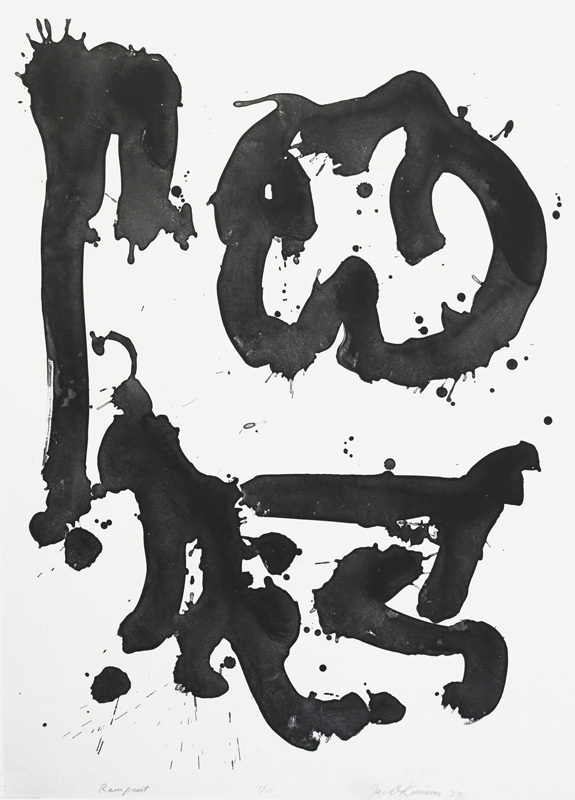
Rampart
Jacob Kainen
Rampart
Jacob Kainen
1909 - 2001 (biography)Jacob Kainen’s dismissal of both labels and the art world’s demand for categorization led him to freely explore styles at his own pace. In the simplest terms, his style began in representation and ended in non-representation, but aside from these contributing factors the path of his creativity remained delightfully unexpected throughout his career. One small common thread is evident, however: the theme of symbols. From the smallest etching of a city scene to the largest intaglio abstraction, the viewer will likely find some semblance of symbology within the work.
Kainen experimented with different mediums and explored many styles, yet he identified himself as a painter. His work took root in the Social Realism of the 1930s and the WPA, later becoming involved in the development of Abstract Expressionism. Fiercely independent and anti-establishment, he rejected labels and moved from visceral abstractions to figurative work to abstraction again, refining these styles at his own pace. His work became well known for its variations and diversity, color, and form, and explorations of light and space.
Jacob Kainen was born to Russian immigrants in Waterbury, Connecticut on December 7, 1909. In 1918, the Kainen family moved to the Bronx and Jacob attended DeWitt Clinton High School where he graduated in 1926.
In 1927, Kainen entered Pratt as a painting student but he was so rebellious and impatient that his various antics gave cause for the administration to expel him three weeks before graduation in 1930. Kainen joined the John Reed Club and at the club’s meetings he met Diego Rivera, Henry Glintenkamp, George Ault, Hilaire Hiler, and Stuart Davis. In 1934, he had his first chance to exhibit at the American Artists School.
When the government sponsored Works Progress Administration’s (WPA) Federal Art Project was inaugurated in 1935, Kainen registered for the graphic arts project. That same year he became a contributor to Art Front, the journal of the Artist’s Union and later served on its board. He also had his submissions accepted by The Daily Worker and The New Masses. In 1940, Kainen had his first solo exhibition mounted at the A.C.A. gallery.
In 1942, Kainen was hired as an aide in the Division of Graphic Arts at the U.S. National Museum (now the National Museum of American History) in Washington, D.C. and, in 1944, his job became permanent. Two years later he was appointed curator of the Division of Graphic Arts. The collection was in dire need of direction, growth, and conservation and Kainen flourished as its curator mounting monthly print exhibitions and acquiring works. Kainen also worked as curator of prints and drawings for six years at the National Collection of Fine Arts (now the Smithsonian American Art Museum) and he retired from the Smithsonian in 1970.