
Aftermath by Doris Seidler
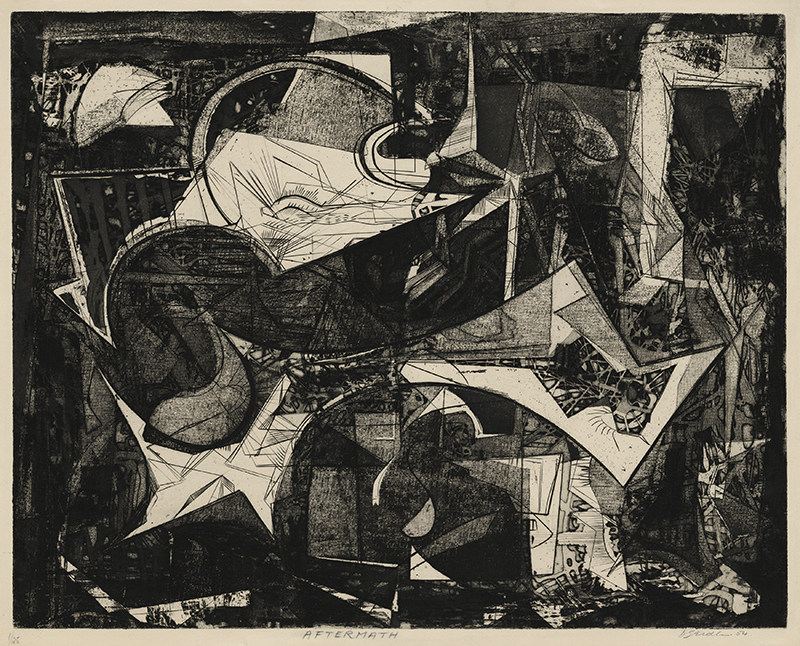
Aftermath
Doris Seidler
Title
Aftermath
Artist
Doris Seidler
1912 - 2010 (biography)Year
1954
Technique
etching, aquatint, soft-ground etching & engraving
Image Size
15 7/8 x 19 3/4" platemark
Signature
pencil, lower right
Edition Size
1 of 25
Annotations
pencil titled in lower left and dated after the signature; also inscribed by the artist "collection D.S. / Reviewed by N.Y. Times / Exh. SAGA / Library of Congress / British Museum 1992"; Verso:"Atelier 17 / Award"
Reference
British Museum 1990,1215.36 [their impression is illustrated with the signature running down the left margin)
Paper
ivory wove
State
published
Publisher
artist
Inventory ID
DOS159
Price
$2,700.00
Description
Doris Seidler, British by birth, began working with Stanley William Hayter at Atelier 17 in New York in 1940 and spent almost 10 years working there. This remarkable print is another example of Seidler trying to "destroy the plate" using different intaglio techniques, including etching, aquatint, soft-ground etching and engraving. Seidler loved drawing and collage and this contains a variety of drawing techniques for which she used engraving tools, with the feeling of a collage, accomplished by pressing fabrics and other materials into the soft-ground. The title, "Aftermath" suggests chaos, the results of an accident, an explosion, war, natural disaster - the viewer can decide as their eye wanders into an infinity, through layers of texture and line, light and dark, solid and ephemeral - through aquatint, softground textures and engraved lines and marks. Doris Seidler had been an amateur artist in England before her marriage and later, in her husband's business absences, Hayter accepted her as a participant in his wartime printmaking classes in New York in 1940, exposing her to the experimental approachs of Atelier 17. After returning to England in 1945 she emigrated to the US in 1948 and returned to working in the New York studio into the 1950s. As an associate of Hayter's she learned not only the diverse techniques of gravure, but a philosophy centered on Hayter's overriding principle, "adequate motive", which meant that superb skills are not enough.