Taches de Rousseur (Freckles) from 'La Memoire Elementaire' by Alexander Calder
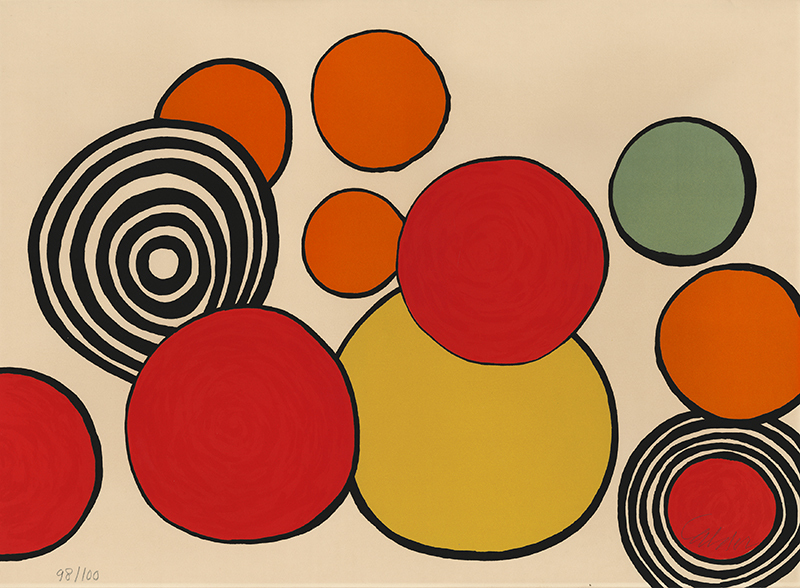
Taches de Rousseur (Freckles) from 'La Memoire Elementaire'
Alexander Calder
Taches de Rousseur (Freckles) from 'La Memoire Elementaire'
Alexander Calder
1898 - 1976 (biography)"Taches de Rousseur"(Freckles) was published by Éditions de la Différence in two editions, this, an edition of 100, printed on Arches wove paper and numbered in Arabic and another edition of 50, printed on Japon Nacre paper, editioned with Roman Numerals.
This classic Calder image is from a series he titled "La Memoire Elementaire" (Elemental Memory) that had to do with the basic shapes and elements used by humans to communicate. Circles and spirals interact, different sizes and colors are balanced on the surface of the paper.
American sculptor, painter, and printmaker Alexander Calder was born in 1898 in Lawton, Pennsylvania, into a family of noted Philadelphia artists. His father was a sculptor whose works were found throughout the city and his mother was a professional portrait artist, trained at the Academie Julian and the Sorbonne in France. Despite the accomplishments of his parents, it was their wish that he not pursue fine art as a career, though they did not discourage his interest in it as a hobby. Thus, his study of art was mainly self-directed.
Due to the ailing health of Calder's father, the family moved with some regularity beginning in 1909, to Arizona, California, then New York and back to California again, each time reserving space for Calder's studio. He chose to remain in San Francisco for his high school years in order to earn his diploma and, following graduation in 1915, he enrolled at the Stevens Institute of Technology in Hoboken, New Jersey, for mechanical engineering. He received his degree in 1919 and went to work as a hydraulic engineer and draughtsman for the New York Edison Company. After a brief stint on a passenger ship, in which he was inspired by the scenery of the coasts along which he traveled, he returned to New York once more, enrolling in the Art Students League to officially pursue art.
Calder studied painting, printmaking, and drawing under leading ASL teachers Thomas Hart Benton, George Luks, Kenneth Hayes Miller, and John Sloan. In 1926 he moved to Paris to enroll at the Academie de la Grande Chaumiere, establishing a studio in Montparnasse. While there he met a Serbian toy merchant in Paris, who suggested he try making mechanical toys. This spurred his first art sculptures, make of wire, cloth, rubber, cork, and other found objects, which led to his creation of wire sculpting, or "drawing in space," the technique he would become known for. This mechanical ballet between space, shape, and energy would transfer to his printmaking and painting style. His first solo exhibition was held in 1927 at the gallery of Jaques Seligmann; the following year his work was added to the major New York venue the Weyhe Gallery.
In 1931 he joined the Abstraction-Creation group and befriended Arp, Leger, Miro, and Mondrian. This was a major turning point for the already rising star. He began to exhibit with regularity and by 1943 he was considered one of the world's foremost Abstract artists, with the Museum of Modern Art holding a Calder retrospective curated by James McSweeney and Marcel Duschamp (who also dubbed his kinetic works"mobiles"; Jean Arp would later christen his static sculpture "stabiles"). In the 1950s Galerie Maeght became his exclusive Parisian dealer, holding annual exhibits of his work.
Calders' work is now held in major museums and collections around the world, including the Guggenheim, the Whitney, the Centre Georges Pompidou (Paris), the Museo Nacional Centro de Arte Reina Sofia (Madrid), and the National Gallery of Art, Washington, D.C., among many others.
Calder died in 1976, shortly after the opening of a major retrospective of his work at the Whitney Museum.