
Exuberance by Dorr Bothwell
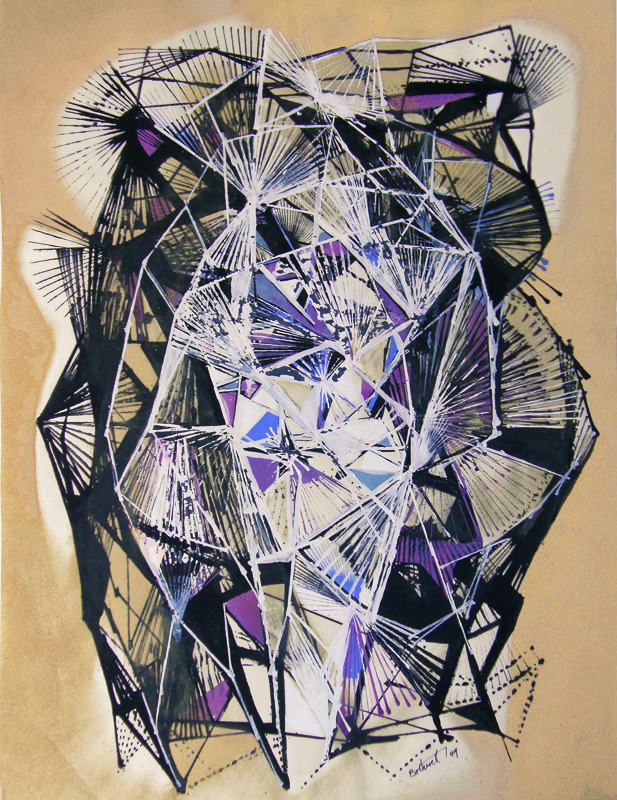
Exuberance
Dorr Bothwell
Exuberance
Dorr Bothwell
1902 - 2000 (biography)By 1947 Dorr Bothwell, who had been formally pursuing art for over 25 years, had shed the realism and classical subject matter she had learned in order to fully delve into the abstract. By this time she referred to herself as a Symbolist and applied the theory to her abstracted compositions; as well, in many of these mid-century works there is abundant use of patterns that echo her time on the islands of American Samoa, where she learned about the textile production and tattooing designs of the islanders.
Throughout the 1940s Bothwell experimented with Surrealism and the abstraction that arises from exploring its gestural aspects, such as with this drawing, which lives up to its title. "Exuberance" is a structured explosion of black and with lines and touches of color, done using watercolor, ink and casein in 1949. The outer edges of the the composition is painted with a brown wash, creating a halo of light around the central "Exuberance".
Dorris Hodgson Bothwell, known as Dorr, was born in San Francisco in 1902. Her family moved to San Diego in 1911 and Bothwell began her art studies five years later with Anna Valentien. She returned to San Francisco in 1921 and enrolled in the California School of Fine Arts where she was greatly influenced by Gottardo Piazzoni. Bothwell continued her studies at the University of Oregon, Eugene and then returned to San Francisco where she attended the Rudolph Schaeffer School of Design.
Bothwell moved to San Diego and then to Los Angeles where she joined the circle of post-surrealists which included Lorser Feitelson and Helen Lundberg. She studied under Feitelson in classes organized by the Public Works of Art Project and she was accepted into the mural division of the WPA where she painted murals in Los Angeles, Riverside, and San Francisco.
In 1968, Bothwell and Marlys Mayfield co-wrote the book 'Notan: The Dark-Light Principle of Design,' which encompassed the principles developed in her teaching. She received the Abraham Rosenberg Fellowship, the 1979 San Francisco Women in the Arts award, and was twice awarded Pollock-Krasner grants.