
Pl. CCV: Phlox Fig. 1/Fig. 2... (after Robert Lancake) by John Miller
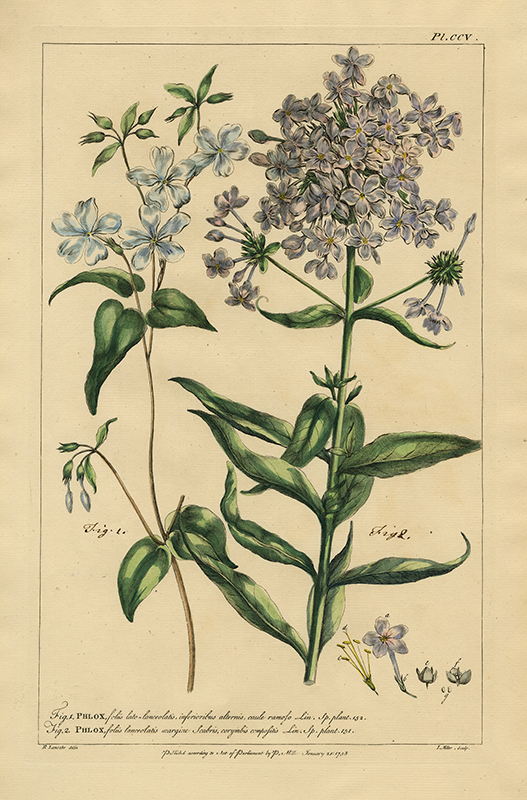
Pl. CCV: Phlox Fig. 1/Fig. 2... (after Robert Lancake)
John Miller
Pl. CCV: Phlox Fig. 1/Fig. 2... (after Robert Lancake)
John Miller
1715 - 1792 (biography)Phlox, Foliis lato-lanceolatis and Phlox, foliis laneolatis margine scabris, are figures 1 and 2 of plate CCV from Figures of the Most Beautiful, Useful, and Uncommon Plants described in the Gardener's Dictionary. The folio of 300 engraved plates was a follow-up to the major botanical tome, The Gardener's Dictionary, written by Phillip Miller (1691-1771), London's chief gardener at the Chelsea Physic Garden and a member of the Botanic Academy of Florence.
The original publication, written by Philip in 1731, was sparsley illustrated. Between 1755 and 1760 a two-volume folio of 300 hand-colored engravings was commissioned by an Act of Parliament, each detailing a particular plant's physical traits. Several artists were involved, including John Miller (born Johann Sebastian Müller, Germany) who recreated the drawings of Richard Lancake (fluent ca. 1755-1760) for the folio.
Kalmia, foliis lanceoato is plate CCXXVIII from Figures of the Most Beautiful, Useful, and Uncommon Plants described in the Gardener's Dictionary. The folio of 300 engraved plates was a follow-up to the major botanical tome, The Gardener's Dictionary, written by Phillip Miller (1691-1771), London's chief gardener at the Chelsea Physic Garden and a member of the Botanic Academy of Florence.
The original publication, written by Philip in 1731, was sparsley illustrated. Between 1755 and 1760 a two-volume folio of 300 hand-colored engravings was commissioned by an Act of Parliament, each detailing a particular plant's physical traits. Several artists were involved, including John Miller (born Johann Sebastian Müller, Germany) who recreated the drawings of Richard Lancake (fluent ca. 1755-1760) for the folio.
Phlox is found mostly in North America, though a species is found in Siberia as well, and it is named for the Greek work for "flame." A hardy pollinator plant, it is found in a wide variety of habitats from alpine to desert to prairie, and attracts insects, deer, rabbits, and groundhogs. The Gardener's Dictionary, though primarily focused on plants from the British isles, included several instances of plants from throughout the globe.