
'Fudo Myoo's Twenty-Eight Forms,' (No. 11 from the portfolio) by Kuntaro Hayakawa
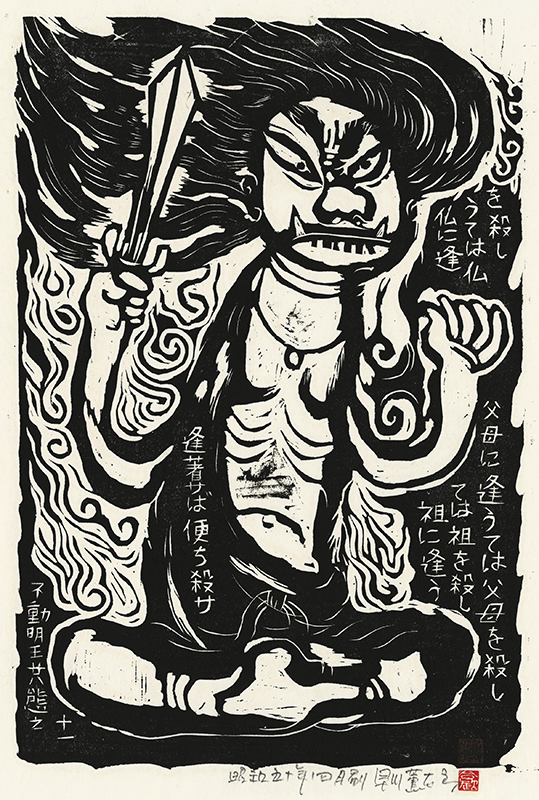
'Fudo Myoo's Twenty-Eight Forms,' (No. 11 from the portfolio)
Kuntaro Hayakawa
'Fudo Myoo's Twenty-Eight Forms,' (No. 11 from the portfolio)
Buddhism is not always just about peace and serenity, this dramatic woodcut is from "Twenty-Eight Depictions of Fudo Myoo," a portfolio of large woodcuts showing the Japanese Buddhist deity Fudo Myoo, also known as "Acala." Acala began as an esoteric deity in the broader Mahayana Buddhist philosophy. He was adopted into Japanese culture and given a more formal standing in Japanese Buddhism in the 9th century by the monk Kukai. Acala is the Immovable God, the principle deity of the Five Wisdom Gods. They are depicted as wrathful beings, though in Japanese Buddhism their aggressive nature is intended to banish negative forces within the self, acting as a facet of Buddha's universal compassion for all.
This portfolio shows Acala/Fudo Myoo in the many forms he developed in the Heian and Kamakura eras: often depicting him with one eye looking upward, the other down ("heaven-and-earth eyes"), with one fang pointing up and the others pointing down as well. These are intended to represent Acala's duality. His head is often ringed in a halo of flames that represents the fire-breathing Garuda bird, and he holds a sword of wisdom and a negative force-binding noose.
Japanese printmaker Kuntaro Hayakawa (also known as Kaorutaro Hayakawa) likely created these images in the 1970s, the portfolio is dated Showa 50 (April 1975) and appears to be greatly influenced by expressive printmaker Shik? Munakata. We have searched the internet and our library for more information on the artist and on the portfolio, any help would be most appreciated.