
Korean 'Dang Saju' fortune teller's book by Unidentified Asian
Korean 'Dang Saju' fortune teller's book
Unidentified Asian
Korean 'Dang Saju' fortune teller's book
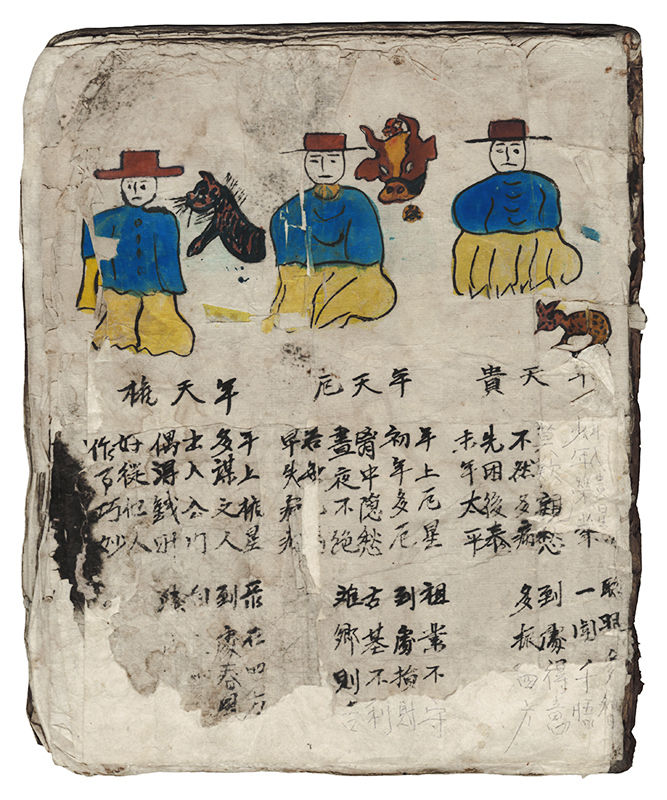
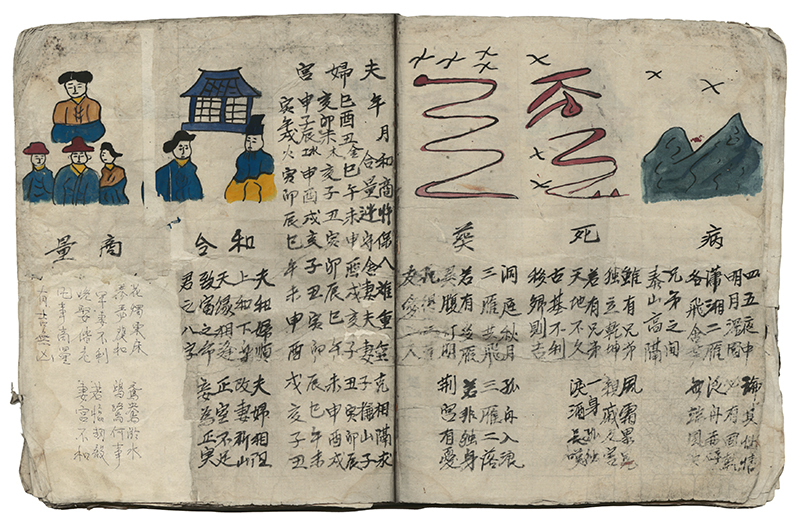
A heavily-consulted Korean "Book of Fortunes" known as Dang Saju (people's fortune telling). Influenced by the Tang Dynasty's divination systems and based on the more in-depth Saju technique, this simplified, folk-style copy likely belonged to a fortune-reading family and used as a source of income for many generations. Its forty-one pages are well-worn, extensively repaired, and though the cover is missing, the book still retains a fairly secure binding. Where parts of the original hanji (mulberry paper) wore away, someone has made repairs with newer hanji and replaced the missing ink-brush text using a ball-point pen - hinting at the expanse of time during which the book was used. Of note, however, are the last two pages (book is read right to left) which are missing portions that were never repaired.
As noted above, Dang Saju is the simplified, more pictorial version of Saju, the "Four Pillars of Destiny," which utilizes a highly systematic process to chart one's "pillars" (birth year, month, day, and hour) and their corresponding two characters (Heavenly Stem and Earthly Branch) to determine likely outcomes in one's future. Several factors are taken into the Saju readings, based on the Five Elements (Wood, Fire, Earth, Metal, Water) and looking at an individual's "Grand Fortune" ten-year cycles.
Dang Saju distills this complex fortune-telling process by using a chart of twelve stars (a Zodiac), each representing an animal or archetype whose movements are the determining factors in the positive and negative outcomes of a person's life. This faster, more easily-interpreted method made it easier for fortune-tellers to move throughout their community to earn a living. Using tents, tables, and a candle, their readings were available street-side and were more accesible to everyday people.
Today, Dang Saju is still practiced by fortune-tellers even with the advent of apps and websites. Generational knowledge is still considered a requisite to those who take the readings of their fortunes seriously.