
Koi by Janet Turner
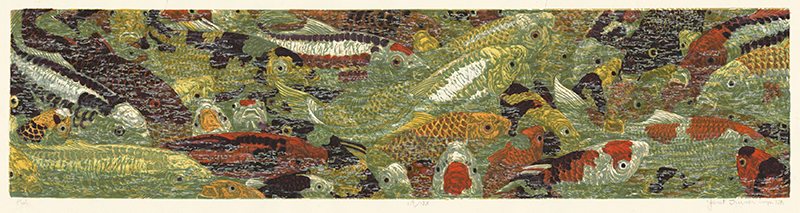
Koi
Janet Turner
Koi
Janet Turner
1914 - 1988 (biography)Chico, California printmaker/teacher Janet Turner began combining printmaking techniques in the mid 1950s and by the 1960s was making it integral to her images, as with this composition, done in 1976 in a variant edition of 185. She used both color linocut, a relief process, and screenprinting (serigraphy), a stencil process. She signed this adding the abbreviations "NA" indicating her membership in the National Academy, and "imp" which indicates that she printed the impression herself. As is usual with artists' self-printed color prints the coloring will vary from impression to impression.
"Koi" is one of the last prints Turner finished, this using 2 linoleum blocks and silkscreen (also screen-print or serigraph), done in 1979 in an edition of 185. She depicts a pond swirling with koi fish various sizes, patterns, and colors, most likely at feeding time. In 1976 Turner toured Japan and probably found her inspiration for this complicated composition.
Turner's subjects were often informed by the world of nature and wild creatures, especially the avian members. Turner commented about her work: "...My work comes from my evolving knowledge of social, biological and ecological relationships. My observations through my art have led to new awareness and have increased my sense of amazement, wonder, my concern about man's impact on the world, a feeling perhaps imperfectly conveyed to others. I am awed by the richness of nature, interested in details of fur and feathers, which have meaning because they evolved from the relationship of one thing to another..."