
Pl. I from "NUS - Cent Photographies Originales de Laryew" by Stanislaw Julian Ignacy Walery
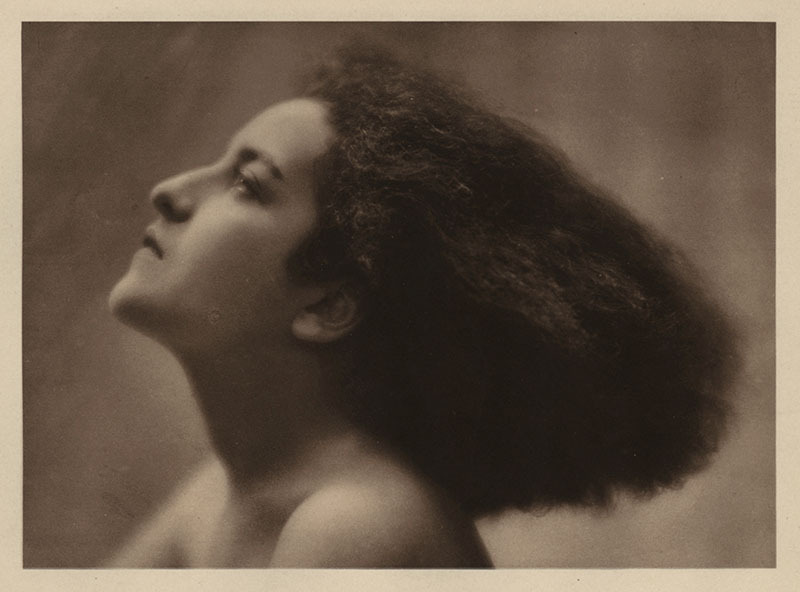
Pl. I from "NUS - Cent Photographies Originales de Laryew"
Stanislaw Julian Ignacy Walery
Pl. I from "NUS - Cent Photographies Originales de Laryew"
Stanislaw Julian Ignacy Walery
1863 - 1929 (biography)A profile portrait of a young woman whose curly hair has been brushed out and back, face titled upward. With her bare shoulders, elongated neck, and carefully arched brows, her portrait becomes an elegant, sculptural composition. The subject of this photo is Lena Amsel, a Polish-born Jewish dancer and silent film actor. Her family's prosperity allowed for her to pursue her career unfettered, and she became a part of the avant-garde and bohemian scenes of Berlin, Vienna, and Paris. Tragically, she died in a car crash in 1929, just as her film career was gaining traction. Her friend, writer and fellow actor Ruth Landshoff (German; 1904-1966) wrote a novel based on Amsel's life, Roman einer Tanzerin (A Dancer's Novel) in the 1930s. However, due to her own status as a Jew, was unable to find a publisher as Hitler rose to power. It was finally published in 2002, thirty-six years after Landshoff's death.
This is the first plate from the portfolio "NUS" ("Naked") and was credited in the title to Laryew, an anagram used in an effort to separate Stanislas Walery's erotic work with his more formal photography, as well as the work of his father. NUS included 100 heliogravures of nude women in various poses ranging from classical to modernist; some featured stark, angular lighting and architectural details, lending them a machine-age, Art Deco style. It is thought that these women are dancers from the popular Folies Bergere, a subject he frequently revisited.
A note on the Walery name: The photographer most commonly known as Stanislaw Walery was born Stanislaw Julian Ignacy, Count Ostrorog, but went by a variety of acronyms and psuedonyms, including "Laryew", an anagram of Walery. Correct accounting of his work and history is further confused by having inherited his father's name (Stanislas Julian Ostorog) and photography business, as well as his use of his mother's surname (Walery, originally Waleria) - spelled the same as the noted late-19th century photographer Walery Mroczkowski, and used as well by the man who took over the photography shop from Walery himself, Charles Auguste Varsavaux, a.k.a. "Lucien Varsavaux dit Walery".
This confusion unfortunately led to a partially unmarketable body of work. Despite this, NUS and other portraits from this era are considered among the best examples of experimental Art Deco photography.