

Venise by Kaiko Moti
Venise
Kaiko Moti
Venise
Kaiko Moti
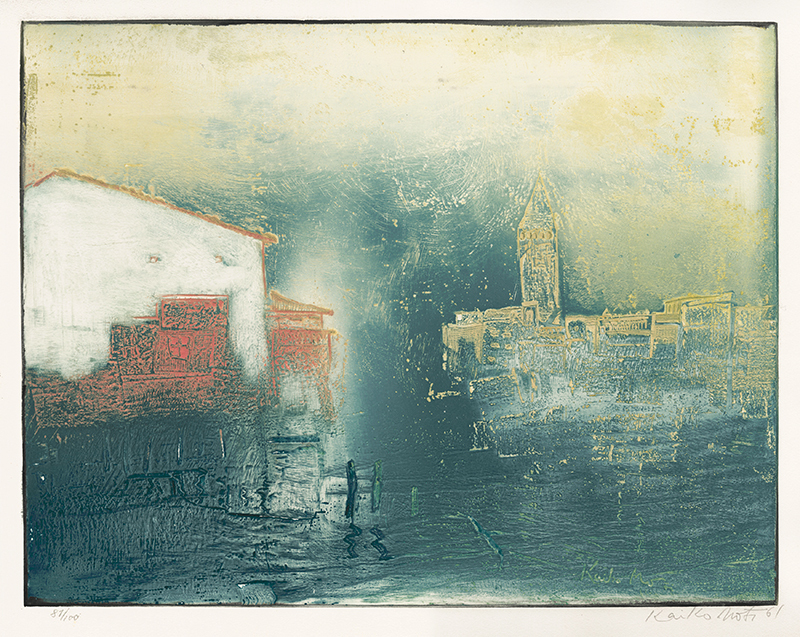
1921 - 1989 (biography)In this early, multi-technique intaglio, Kaiko Moti's signature style begins to emerge in the softly blended, painterly quality he achieves on the plate. Venice's famed sea-level architecture emerges from the mist, and are reflected in the quiet waters below. Moti's foray into printmaking in the early 1950s was informed by classical training in painting and drawing, which carried over into the intaglio processes he discovered in 1952 at Atelier 17 in Paris.
Moti would prove to be a pioneer of the metal plate printmaking medium, coaxing delicate, complex imagery from the plate in a way that most 20th century printmakers had not. Though his peers were primarily interested in the uncharted territory of Abstract Expressionism, Moti was inspired by Old Master and Romantic artists that he was first introduced to in his early years at the Bombay School of Fine Arts. He was especially drawn to the tonality and atmospheric nature of landscapes and seascapes, and how the mood changed with the light.
Kaiko Moti was born Kaikobad Motiwalla in Bombay, India in 1921. He began private design classes at age fourteen and, between the years 1939 and 1946, he attended the Bombay School of Fine Arts. Moti moved to London, England in 1946 and continued his art studies at the Slade School of Art of the University College, where he received his Masters Degree in painting and sculpture. Additional studies in sculpture and painting took place in the studios of F.E. Macwilliam and Reginald Butler.
By 1950 Moti had relocated to France, settling in Paris where he would eventually become a permanent resident. He attended the Academie de la Grand Chaumiere and studied sculpture with Ossip Zadkine at his atelier. However, his discovery of intaglio printmaking in 1952 at Atelier 17, under experimental printmaker Stanley William Hayter, led to a lifelong passion for etching and aquatint. At the workshop he and his countryman Krishna Reddy would pioneer many techniques in the new field of viscosity printing, developing a painterly tonality on the plate that was greatly informed by Old Master and Romantic painters such as J.M.W. Turner.
Moti began exhibiting in 1953, and showed internationally at the Venice Biennale, the Bibliotheque Nationale, the Basel Art Fair, the Art Expo and the New York Public Library. He won various awards and is represented in the permanent collections of the Victoria and Albert Museum, the Paris Musee d’Art Moderne, Bibliotheque Nationale, and the Hammer Museum at University of California, Los Angeles. Moti was an honorary member of the Academy of Florence. Moti died in Paris in 1989.