
Caged Bird by Walter Henry Williams
Caged Bird
Walter Henry Williams
Caged Bird
Walter Henry Williams
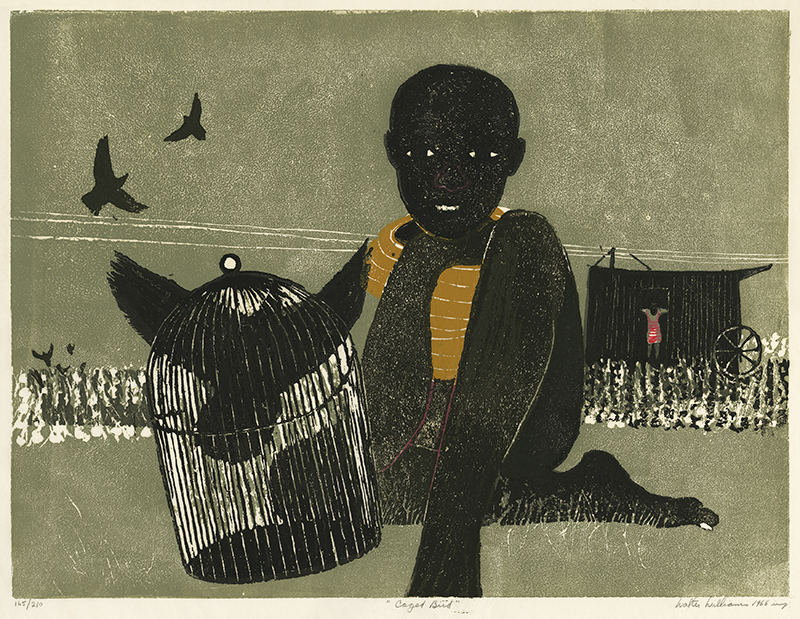
1920 - 1998 (biography)Caged Bird was published by the International Graphic Arts Society, January 1967, Series #72. Published in editions of 210, 100 impressions were sold in America and 100 in Europe. There were 10 artist's proofs. Williams printed his own works and the colors within the edition and impressions will vary from one to another.
The symbolism of this work can only be pondered by the viewer, as it seems Williams did not mention a specific meaning for Caged Bird. The ongoing crisis of Jim Crow-era racism and violence toward Black people in the U.S. was documented at the time but still largely ignored by white policy makers. Additionally, Williams' own personal past was clouded with grief and fear: the early death of his mother; the authoritarian cruelty of his father; being Black in America - these were all parts of his story.
However, it's also known that Williams was living in Denmark at the time, and it's possible that he was exposed to the infamous series of photos of Belgium's horrifying "human zoos." Active from the late 19th century until 1958, the "zoos" were remnants of the reign of King Leopold II. His brutal colonization of the Congolese people wiped out up to 15 million people; following this, from 1909 onward, Belgium would put Black Congolese people on display in cages for white patrons to ogle during summer fairs. In 1955, a series of photos documented this horrifying spectacle.
One such photo shows a small Congolese boy no older than four, sitting as the boy in Caged Bird sits, within a domed cage as one might use to house a parrot. Outside of the cage sits two white Belgian girls, staring in at the boy and grinning. We believe it may be possible that Williams made this work in reaction to that photo; within the context, the image of a bird spreading its wings beyond its cage may have been to offer a sense of hope - albeit a hesitant one. As time has shown again and again, a Black child in a colonized society is rarely free to completely abandon himself in daydreams, lest he break a societal rule of which he is an unwitting victim.
Strife and fear leftover from the days of Leopold still effect the Democratic Republic of Congo today. As always, it is the job of art and artists to remind us of what was, is, and can be.