The Exile Called Clown by Hiroyuki Tajima
The Exile Called Clown
Hiroyuki Tajima
The Exile Called Clown
Hiroyuki Tajima
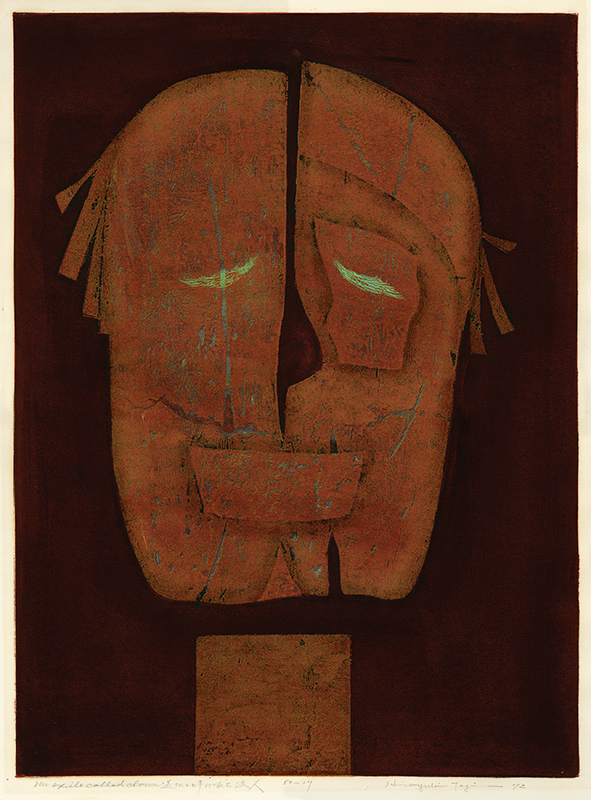
1911 - 1984 (biography)Though this large image of an abstracted face is technically a woodcut, Tajima applied collagraphic techniques to the surface of the block to create dimensionality and texture to the print.
Tajima's experimental printmaking set him aside from many Japanese Abstract artists of the mid 20th century. He incorporated techniques he learned in photography and oil painting to give depth to his prints, and would build up his matrices with crumpled or torn paper and natural materials, which he would then shellac before applying his own deeply pigmented inks.
The clown as a symbol of isolation and loneliness became a focus of Tajima's work from the late 1960s to the early 1970s. A series of large prints portrayed the "clown" as almost totally abstracted ("Michiyuki mono" - "A Clown," 1968) with only the suggestion of facial features assembled on a geometric field of color, to the more representational, if very surreal, Magritte-like style of "Serious Clown" (1972). In "The Exile Called Clown" he combines a stilted, frozen smile with downturned eyes to form a polarized caricature of the normally cheerful clown persona.