
Wien: k. u. k. Reservespital Katharinenhalle by Max Pollak
Wien: k. u. k. Reservespital Katharinenhalle
Max Pollak
Wien: k. u. k. Reservespital Katharinenhalle
Max Pollak
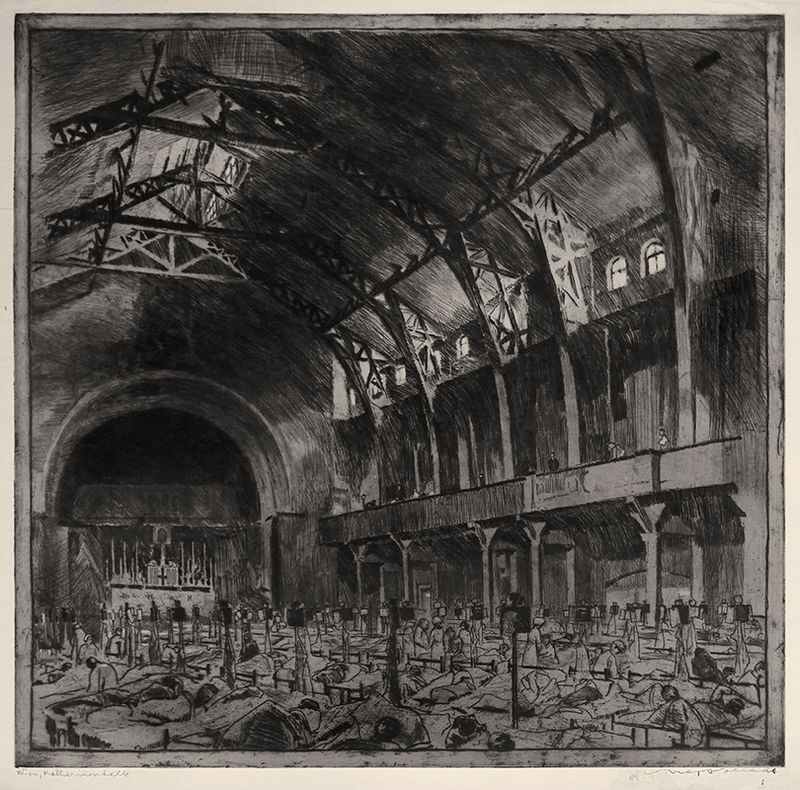
1886 - 1970 (biography)This large intaglio was likely created when Pollak was employed as an artist by the Austrian Army to chronicle World War I. He would base several early etchings on his wartime observations. This structure was located in Weigl's Dreher Park, Vienna. It was an indoor ampitheater built for the International Music and Theater Exhibition in 1892, and could hold 4,000 occupants. It changed hands several times but was always a place of entertainment and was in service through 1925, when it was demolished.
In this composition, Pollak illustrates one of the building's brief but necessary transformations: as Reserve Hospital Number 4, an auxiliary unit for wounded soldiers of World War I in 1916. Hospital beds are arranged, row after row, on the floor that in peaceful times was meant for dining and dancing. Hospital workers watch over them from the upper balcony. "k. u. k." stands for imperial and royal as is an abbeviation used duirng the Austro-Hungarian Empire (2867-1918) for joint institutions like the military. A Reservespital is a reserve military hospital.
Max Pollak, painter and printmaker, was born in Prague, Czechoslovakia in 1886, was raised in Vienna, Austria and, in 1902, he entered the Vienna Academy of Art where he studied under William Unger and Ferdinand Schmutzer. In 1912, Pollak traveled to Italy, France, and Holland to study and paint. During the First World War, he was appointed painter for the Austrian Army and documented the stark landscapes where his battalion was stationed. Pollak was anti-war and would frequently chronicle the prisoners of war and war refugees.
He produced a portfolio of etchings, "Im Barackenlager Nikolsburg", which illustrated the daily denigration of the Galician Jews who were forcefully relocated to barracks in Nikolsburg, Moravia. For this he was punished by the government and sent to work making casts of war machinery in a factory. The Pollaks, Max and Friedl, immigrated to the United States in 1927, living for a time on the east coast where he produced a series of color aquatints of New York, Cincinnati, and Detroit. His first exhibition was at the 57th Street Art Gallery in New York and he was commissioned by Theodore Dreiser in 1929 to illustrate his book, 'My City.'
In 1938 Max and Friedl moved to San Francisco, California. Pollak was inspired by his new city and its environs and produced beautiful views of San Francisco Bay Area. Later travels included trips to Mexico and Guatemala. Max Pollak was a member of the Chicago Society of Etchers and the California Society of Etchers.