
Under Sea Ballet by Ian Hugo
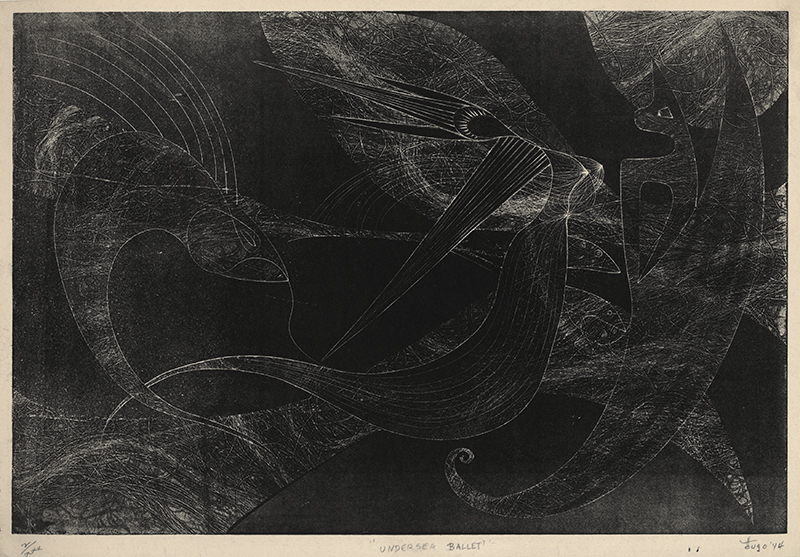
Under Sea Ballet
Ian Hugo
Under Sea Ballet
Ian Hugo
1898 - 1985 (biography)There is an impression of "Under Sea Ballet" in the British Museum. In 1942 Hugo's wife, author Anais Nin, was looking for a publisher for her book "Under a Glass Bell." When she could not find one she and Hugo (Hugh Guiler) started Gemor Press with Hugo creating a series of copper engravings, printed in relief as illustrations. "Under Sea Ballet," was done in a format that could be used for the cover, but was not selected, the image "Under a Glass Bell" was finally decided upon.
Though editioned at 30, each impression of "Under Sea Ballet" is printed differently. Hugo started engraving at Atelier 17 in New York and the experimental nature of the atelier continued through to his work with Anais.
Her publication "Under a Glass Bell" is now considered one of Anaïs Nin's finest collections of stories, it was initially deemed unpublishable. Refusing to give up on her vision, in 1944 Nin founded her own press and brought out the first edition, illustrated with striking black-and-white engravings by her husband, Hugh Guiler (Ian Hugo). Shortly thereafter, it caught the attention of literary critic Edmund Wilson, who reviewed the collection in the New Yorker. The first printing sold out in three weeks.
Many of the prints printed at Atelier 17 were not expected to be financial successes, the compositions were experimental and the editions usually would vary from impression to impression. In this case Hugo managed to print his thumbprint in the margin. Forensic evidence in the 21st century.
Ian Hugo, printmaker, illustrator, and filmmaker, was born Hugh Parker Guiler in Boston, Massachusetts on 15 February 1898. His childhood was spent in Puerto Rico but he attended school in Scotland and graduated from Columbia University where he studied economics and literature. Guiler was working at the National City Bank when he met and married author Anaïs Nin in 1923. They moved to Paris the following year where Nin's diary and Guiler's artistic aspirations flowered. Guiler feared his business associates would not understand his interests in art and music so he began a second life as Ian Hugo. Hugo and Nin moved to New York in 1939 and the following year he began working at Stanley William Hayter's Atelier 17 established at the New School for Social Research.
Hugo began producing surreal images that often accompanied Nin's books. For Nin his unwavering love and financial support were indispensable, Hugo was "the fixed center, core...my home, my refuge" (Sept. 16, 1937, Nearer the Moon, The Unexpurgated Diary of Anais Nin, 1937-1939). A fictionalized portrait of Hugo appears in Philip Kaufman's 1990 film, Henry & June.
Responding to comments that viewers saw motion in his engravings, Hugo chose to take up filmmaking. He asked Sasha Hammid for instruction and was instructed, "Use the camera yourself, make your own mistakes, make your own style." Hugo delved into his dreams, his unconscious, and his memories. With no specific plan when he began a film, Hugo would collect images, then reorder or superimpose them, finding poetic meaning in these juxtapositions. These spontaneous inventions greatly resembled his engravings, which he described in 1946 as "hieroglyphs of a language in which our unconscious is trying to convey important, urgent messages." In the underwater world of his film, Bells of Atlantis, all of the light is from the world above the surface; it is otherworldly, out of place yet necessary. In Jazz of Lights, the street lights of Times Square become in Nin's words, "an ephemeral flow of sensations." This flow that she also called "phantasmagorical" had a crucial impact on filmmaker Stan Brakhage who stated that without Jazz of Lights (1954) "there would have been no Anticipation of the Night." Hugo produced fifteen films between 1946 and 1979.
Hugo lived the last two decades of his life in a New York apartment high above street level. In the evenings, surrounded by an electrically illuminated landscape, he dictated his memoirs into tape recorders and would from time to time polish the large copper panels that had been used to print his engravings from the worlds of the unconscious and the dream.
Ian Hugo died in Manhattan, New York City on January 7, 1985.