
Lappen zeichnen ihr Leben - "In kupfer geschnitten von einen Lapplander" by Gustav Hagemann
Lappen zeichnen ihr Leben - "In kupfer geschnitten von einen Lapplander"
Gustav Hagemann
Lappen zeichnen ihr Leben - "In kupfer geschnitten von einen Lapplander"
Gustav Hagemann
1891 - 1982 (biography)German printmaker Gustav Hagemann initiated two series of drypoints titled "Lappen zeichnen ihr Leben" (Lapps Draw their Lives) after drawings done by Lapps (Sámis) of Northern Scandinavia (now known by their traditional name, Sámi Sápmi), the first works done between 1926-1939 when the outbreak of WWII put an end to his travels for nearly two decades.
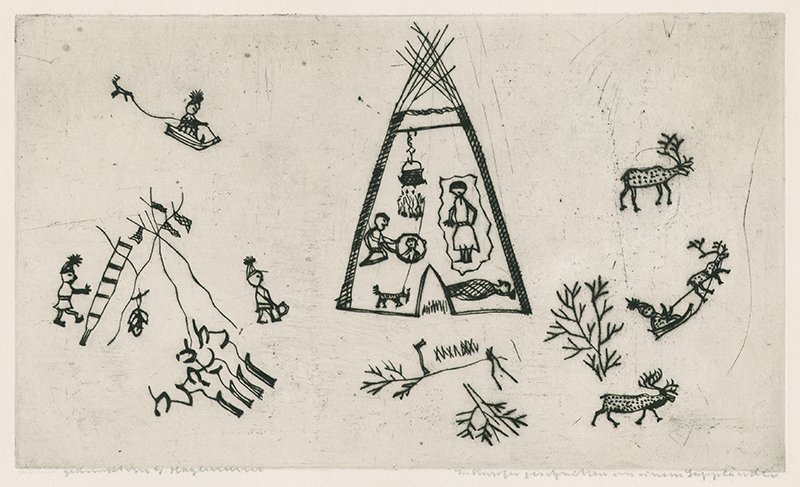
Interestingly, the secondary annotation of this composition translates to "Cut in copper by a Lapplander", after Hagemann invited the Sámi artists to directly etch the plate themselves, rather than himself. Either way, these etchings are extraordinary depictions of everyday life in the Sámi villages of Finland, Norway, Sweden and Russia at a time when few people ventured so far north for their art. The plates primarily depict reindeer herders and fishermen, but some also include records of traditional clothing and the everyday lives of entire families. The work is characterized by the absensce of linear perspective and the simultaneous depiction of non-simultaneous events, with different dimensions depicted on a single plane. These works were of interest to the European printmakers.
The full portfolio number one of Sámi Sápmi images first was shown at Galerie Ferdinand Möller in Berlin 1938. The printing was done by German Master Printer Otto Felsing, Kathe Kollwitz's preferred printer. This image depicts a Sámi tent and domestic activities, with reindeer and sleighs being prepared for an excursion.
There was a second portfolio created with engravings done between 1927 and 1964. These works were printed by L. Schwann, Düsseldorf, Germany. The concept for producing these drypoints on copper originated with Hagemann, who had seen Sámi incised drawings on objects made of ivory and horn, depicting their daily lives; they selected as the subject the things they knew best, themselves. Hagemann had the copper plates proofed and printed in limited editions in Germany, this example by Otto Felsing.