
On the Sofa by Max Weber
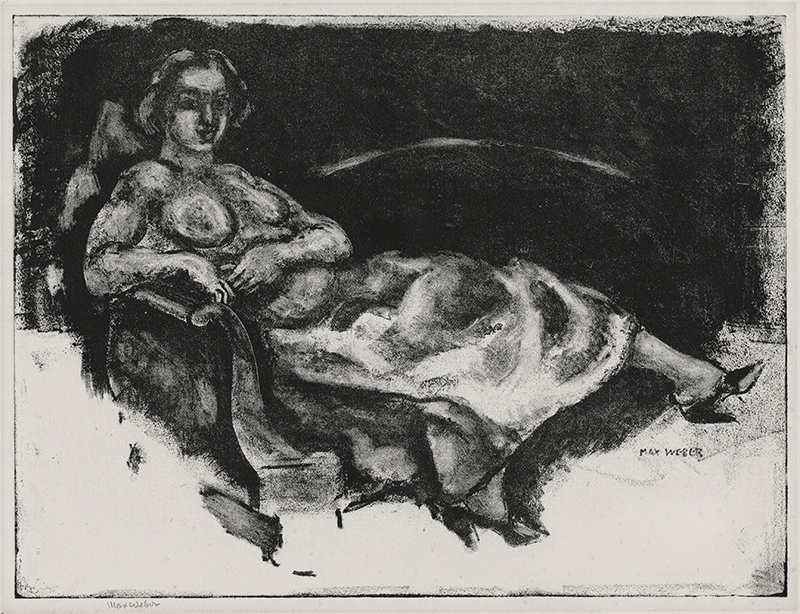
On the Sofa
Max Weber
On the Sofa
Max Weber
1881 - 1961 (biography)Polish born artist Max Weber came to the U.S. at age 10. After studying in New York with Arthur Wesley Dow he returned to Europe between 1905 and 1908 to study art with Henri Matisse at the Academie Julian in Paris. After working with Synthetic Cubism in the teens his work slowly became more representational. This work, "On the Sofa" shows an homage to the work that his original teacher, Henri Matisse, was doing with his lithographs of the 1920s, especially the Odalisques. Weber uses the side of the crayon and probably tusche to create a somewhat cubist inspired composition in blacks and grays in planes, without many lines to add detail.
Artist Max Weber was born on April 18, 1881 in Biatystok, the Russian Empire [now in Poland]. Weber emigrated to the United States and settled in Brooklyn with his Orthodox Jewish parents at the age of ten. He studied art at the Pratt Institute in Brooklyn, New York under Arthur Wesley Dow. Between 1905 and 1908 he lived in Paris, where he studied at the Académie Julian and with Henri Matisse. While in Paris, Weber became a regular at the salon of Leo and Gertrede Stein and formed friendships with the artists Henri Rousseau and Pablo Picasso and other members of the School of Paris.
Upon returning to New York in 1909, he became part of the city's avant-garde circle and was one of the exhibitors at Alfred Stieglitz's "291" gallery where the reception his work received in New York at the time was profoundly discouraging. Critical response to his paintings in a 1911 exhibition there. Art historianer Sam Hunt wrote, "Weber's wistful, tentative Cubism provided the philistine press with their first solid target prior to the Armory Show." was an occasion for "one of the most merciless critical whippings that any artist has received in America."
Between 1909 and 1917 he painted many of his best-known pictures, including the Fauvist-inspired The Geranium (1911) and Chinese Restaurant (1915), a work created in the Synthetic Cubist manner. During this period he favored subjects such as skyscrapers and city interiors. In his figure studies he expressed the dynamism of the American city by fragmenting objects in motion.
Weber evidently was a prickly personality even with his allies. He and Stieglitz had a falling-out, and Weber was not represented in the famous 1913 Armory Show in New York because his friend Arthur B. Davies, one of the show's organizers, had only allotted him space for two paintings. In a fit of pique at Davies, he withdrew entirely from the exhibition. Other artists in the Stieglitz circle kept their distance, especially after Weber told people that there were only three indisputably great modern painters: Cézanne, Rousseau, and himself. "Almost without exception, they found him obnoxious: opinionated, rude, intolerant."
Weber's work became increasingly representational after 1917, but he continued to be fascinated with the exploration of color and form. During the last 20 years of his career many of his paintings were based on Jewish subject matter, especially Hasidic themes. Like many immigrant artists during the 1930s, Weber became active in socialist causes and, in 1937, served as national chairman of the American Artists' Congress, an antifascist (Antifa) artists' group.
Weber taught at the Art Students League in New York, teaching a painting class that the young Mark Rothko attended. Weber's publications include Essays on Art (1916) and Primitives (1926). While lecturing at the Clarence H. White School for Photography, Weber wrote his Cubist Poems that were to be published in 1914. In 1926, the artist released another collection entitled Primitives: Poems and Woodcuts." Weber designed the modernist-style binding for the book, as well as providing eleven woodcuts for the illustrations, first published by Spiral Press in a run of 350 copies, original editions are now rare.
Max Weber died on October 4, 1961 in Great Neck, New York.