

George Grosz Biography
George Grosz
American
1893–1959
Biography
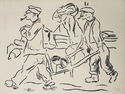
George Grosz, painter, draftsman, printmaker, and satirist, was born in Berlin, Germany on July 26, 1893. He studied at the Dresden Academy of Fine Arts between 1909 and 1911 and under Emil Orlik at the State Teaching Institute of the Berlin Museum of Decorative Arts between 1912 and 1914. He also studied briefly at Atelier Colarossi in Paris. Grosz began his career as an expressionist painter but then he became a member of the Berlin Dada and New Objectivity groups during the Weimar Republic (1917-1933). His most noted work was produced between 1910 and 1930. Grosz became a political satirist who exposed the German political classes and bourgeois society. He also created searing depictions of the Germany's military and industrialists.
Like many European artists fleeing the Nazis, Grosz left Germany in 1933 and immigrated to the United States. Nazi stormtroopers, hoping to arrest Grosz, kicked down the door of his studio two weeks after he left the country. Grosz’s work was featured in the Nazis’ Degenerate Art exhibition in 1937 and he was stripped of his German citizenship in 1938, the same year he became a naturalized citizen of the United States.
Grosz was hired to teach at the Art Students League in New York and was awarded a Guggenheim fellowship in 1937 and 1938. He was active in Provincetown between the years 1937 and 1945. In 1947, Grosz moved to the cottage of the Hilaire Farm Estate in Huntington, New York. He remodeled the cottage into a two-story studio where he worked and taught.
In the United States, Grosz’s work is represented in the Brooklyn Museum, New York; the Art Institute of Chicago; the Museum of Modern Art and the Whitney Museum of American Art, New York; the Portland Museum of Art, Maine; the Hirshhorn Museum and Sculpture Garden, and the National Gallery of Art, Washington, D.C. In 1979, an exhibition of thirty-seven works by Grosz was mounted at the Hirshhorn Museum.
George Grosz died in Berlin on July 6, 1959.