Arthur Degner Biography
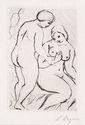
Arthur Degner
German
1888–1972
Biography
Arthur Degner, painter, printmaker, draftsman, and sculptor, was born in Gumbinnen, East Prussia on 2 March 1888. He studied at the Königsberg Academy of Arts under Ludwig Dettmann and Otto Heichert between 1906 and 1908. After a brief stay in Munich in 1909, he moved to Berlin where he exhibited at the gallery of Paul Cassirer. During World War I, Degner performed duties in the medical service. In 1919, he became chairman of the Free Secession and, the following year, he was appointed to the Königsberg Academy. He was also a member of the German Artist’s Association, the Reich Association of Fine Artists, and the German Werkbund. Degner returned to Berlin in 1925 and taught at the Hochschule für Bildende Künste (HBK) and, between 1931 and 1933, he was chairman of the Berlin Secession. Once the Nazis came to power, his work was deemed degenerate. Degner was awarded the Villa Romana Prize from the German Artists’ Association which allowed him to move to Florence in 1936. He was expelled from the Reich Chamber of Culture and six of his paintings were destroyed. In 1943, his studio and all his paintings were destroyed and the following year he was assigned to dig trenches in Poland. He did manage to exhibit his work in twenty-one exhibitions until the end of 1940. After the war, Karl Hofer brought him back to the Hochschule für Bildende Künste, where he was professor emeritus in 1956.
Arthur Degner died on 7 March 1972 in Berlin, Germany.