

Harry Gordon Biography
Harry Gordon
British
1920–2009
Biography
Painter and printmaker Harry Gordon was born in Dartmoor, England in 1920. Little is found on his education or career, and though his work is catalogued in auction records, he isn't listed in David Buckman's Artists of Britain Since 1945 (Bristol, 2006) or elsewhere. The majority of information found on his life is found in an article from June, 2009. Written by Simon Wroe for Camden Town's The Review upon Gordon's death, he talks about a soldier who transformed his trauma and grief as a prisoner of war during the World War II into visual art after returning home.
According to Wroe, there isn't much to report on who Gordon was prior to the war. He was the eldest of five children and his father worked at Dartmoor Prison. He suffered a mental health crisis in high school and was educated at home for a year, and he was drafted into WWII as a paratrooper. In September of 1944 he was taken prisoner after the disastrous Battle of Arnhem. He survived the inital attacks but was captured and forced to march over 3,000 miles from the Dutch city into German prisoner-of-war camps as winter set in. Of the 10,000 Allied troops sent into the Dutch city, only around 2,000 survived. By the time he was freed, Gordon weighed around 90 pounds; everyone he had befriended in his division had died, many of them on the brutal march. The profound trauma he experienced remained a lifelong struggle, impeding his mental and physical health in some form for the majority of his days.
Despite this, Gordon began pursuing visual art, particularly painting. In the 1950s he opened and operated a successful gallery with his second wife, Norah, in Camden Town, London. He was soon given shows in both England and Germany. Such was his popularity that, Wroe notes, he began hanging out with Dylan Thomas, Jacob Epstein, and Louis MacNeice, among other luminaries, and one of his works was purchased by Sylvia Plath as a birthday present for Ted Hughes. However, drinking and frequent sleepless nights contributed to further decline in his mental health. By 1962 he had abandoned the gallery and his marriage to become homeless, living briefly in a cave in Shropshire and then staying wherever anyone would take him in. Periods of creativity continued throughout, though on occasion it would be at the expense of someone's furniture or, in one case, a friend's grand piano - which he had made into a canvas for his painting.
By the late 1960s he had settled into a temporary care home in the Swiss Cottage neighborhood of London. Here, he met a social worker named Maggie. Despite Gordon's obvious struggles, they formed a friendship and then married. They had a son in 1969, and for the next forty years Gordon found a peaceful existence as an artist once more. He no longer participated in the commercial art world again, preferring instead to paint for himself and work as a set designer for local theater and teach art appreciation in Brixton prison.
Harry Gordon remained active as an artist until crippling osteoporosis left him bedridden. He was moved into his studio to be surrounded by artwork in his last days. He died in Herfordshire, England, in June of 2009.
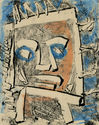
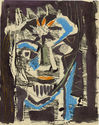
A note on Gordon's style graciously offered by a member of the painting division of Woolley & Wallis Auctions, who responded to our inquiry on Gordon's signature, says, "There would seem to be some influence from the Neo-Romantic artists such as Cecil Collins (1908-1989), John Piper (1903-1992) and John Craxton (1922-2009). The paler subject appears to be a monotype, a form of printmaking that was particularly popular amongst artists working in the UK in the 1950s and 1960s. Even as a minor hand, Gordon seems to have absorbed some of the contemporary styles of that decade."