
Pat Sullivan Biography
Pat Sullivan
Australian/American
1887–1933
Biography
Cartoonist, animator, and film producer Pat Sullivan was born in Paddington, New South Wales (NSW), Australia on February 2, 1887. His early interest in cartooning led to his self-taught style, and in his early 20s he attended art classes at the NSW Art Society to perfect his technique. He then found work as a cartoonist for trade union paper The Worker and the weekly magazine The Gadfly from 1904 to 1907. In 1908 he emigrated to England to work as a performer in music halls and then as an animal handler on trans-Atlantic ships. Meanwhile, he continued to work on his own comics and cartoons as well as collaborations, such as the "Ally Sloper" strip by Charles Henry Ross and Emilie de Tessier.
In 1910 Sullivan emigrated to the United States, settling in Manhattan. To support himself in his first year in the U.S., he worked as a poster designer for cinema and as a boxer. He then began working for the McClure Syndicate under William Marriner, eventually adding his own creations to his daily output. Among these were "Great-Idea Jerry" (1912-1913), "Johnny Boston Beans" (1914), "Obliging Oliver" (1916-19147), and "Old Pop Perkins" (1914). Following Marriner's death in 1914 Sullivan left the editorial cartooning world to try his hand at animation, first for Raoul Barre's studio and then for William Hearts's International Film Service. This proved short lived as he developed a reputation for rampant alcoholism, leading to missed deadlines and abusive behavior as well as lackluster animations. In 1916 Sullivan decided to open his own animation studio and he recruited several up and coming artists to work for him, including Otto Messmer, his longtime collaborator and eventual rival.
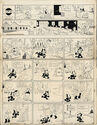
Sullivan's behavior nearly sank the studio several times. Within the first year he had developed a reputation as a blatant racist and a serious alcoholic who was never sober at work, and was convicted of rape. Despite his violent behavior and the increasing reticence of his staff, he was still welcomed into the cartooning world and his studio soon found major success with the development of the Felix the Cat cartoons and comics. Part of the popularity of Felix the Cat was the studio's innovative use of already-drawn comic backgrounds, speech bubbles, and grammatical symbols as items within the stories (for instance, questions marks used to indicate confusion are plucked from over Felix's head and turned into ice skates), as well as Felix's breaking of the fourth wall in both the animations and in the comic strips. This type of spontaneous and experimental styling made Felix one of the most popular characters in the cartoon world by the early 1920s. Several popular songs were written about Felix and in 1927 Charles Lindburgh took a stuffed Felix doll with him on his famous non-stop Atlantic flight. During NBC's first experimental broadcasts, a Felix doll was used as their transmission test subject. Writer Aldous Huxley, French literary critic Marcil Brion, and Hollywood legend Charlie Chaplin sung Felix's praises. Later, Felix would be credited as the primary inspiration for Mickey Mouse.
Despite these successes, Sullivan was his own downfall. He contracted syphilis and, in combination with his severe alcoholism, fell into mental decline. By 1925 his staff rarely saw him in the studio. He would drink himself to death by 1933, and, because he kept no financial books, calendars, or other historical records, reliable testament to his own output went with him. His reputation was then further marred when Otto Messmer stated that Felix was primarily his own creation, a claim that has since found purchase among cartoon historians but remains controversial. Sullivan's true contribution to cartooning, however, remains his ingenuity and willingness to try techniques that no one else had tried before, helping to form Felix into one of the most unique caricatures in history.