
Martin Branner Biography
Martin Branner
American
1888–1970
Biography
Cartoonist Martin Michael Branner was born on December 28, 1888 in New York, New York. He was one of nine children born to Jewish immigrant lacemakers. Before he pursued cartooning, he was a vaudeville dancer and worked as an act manager's assistant beginning in 1905. That year he met dancer Edith Fabbrini and within days the teenagers married, becoming a vaudeville dance team billed as Martin and Fabbrini. They performed their act for fifteen years as part of the Keith Orpheum and Pantages circuits, so popular that they sometimes performed over three times a day. They were among the earliest acts at the Palace Theater in New York.
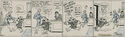
As World War I began to ramp up, demeand for vaudeville shows slowed and Branner found additional work as an illustrator for Variety magazine. He served in the U.S. Army's Chemical Warfare Service and when he returned in 1919 he left vaudeville to pursue a career as a syndicated cartoonist. After testing various strips for a few months, including "Looie the Lawyer" for Bell Syndicate and "Pete and Pinto" for the New York Herald and The Sun, he developed what would become his signature concept, "Winnie Winkle the Breadwinner," with editor Joseph Medill Patterson.
The strip began as a daily before being given a full Sunday page in 1923. The character proved popular partially due to the then-unique premise of post-WWI America: the adventures of a young, unmarried career woman financially supporting her aging parents and adopted brother, Perry Winkle. The strip would become a major indicator of the changing role of women in the 20th century. Inevitably, Branner's willingness to present a woman as autonomous and independent - even with her stereotypical feminine beauty and charm - meant that he was presented with censure and other roadblocks. During World War II, Winnie's storyline included the disappearance of her soldier husband, leaving her alone and pregnant. A pregnant widow was too controversial for some readers, with various publications censoring that storyline and the Baltimore Sun dropping the comic altogther. However, the strip continued until 1996 and included contemporary issues such as PTSD in Vietnam veterans and Winnie's involvement in the Peace Corps.
The Branners settled in Waterford, Connecticut where they raised two sons. Martin Branner was honored in 1958 with the Humor Comic Strip Award from the National Cartoonists Society. He continued the strip until his retirement in 1962 when he handed it over to his assistant Max Van Bibber. Branner died on May 19, 1970, in New London, Connecticut.