
Margarete Ann Walters Biography

Margarete Ann Walters
American
1924–1971
Biography
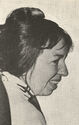
Margarete Ann Walters (née Marjorie), painter, printmaker, poet, and free-lance artist, was born in Pendleton, Oregon, on December 7, 1924. Shortly after Margarete’s birth, her mother suffered a debilitating mental illness which required her to be institutionalized. Her father, unable to care for his two daughters, eventually placed his young girls in a local convent-style orphanage at St. Joseph’s School. Margarete graduated from St. Joseph High School in Pendleton in 1942. She attended the University of Idaho in Moscow in the late 1940s, receiving her B.A. degree in 1950. She continued her education at the College of Arts and Crafts in Oakland, California, and received her M.F.A. in 1951. Margarete taught art at Dominican College in San Rafael, California, between 1951 and 1953.
From 1954 to 1959, Margarete lived in Europe where she first studied the art of mosaic at the Scuola Grande dei Carmine in Venice, Italy. She then spent two years studying monumental decorations in Paris, and the final two years she worked at Stanley William Hayter’s Atelier 17 in Paris.
Margarete moved to Boston, Massachusetts in 1964 where she opted to live in the South End. She was deeply religious and chose to live her life in “her quiet, cheerful and authentic practice of poverty.” She often dedicated her free-time to teaching art to the under-privileged children in her neighborhood and she was known to give away food and money to those in need.
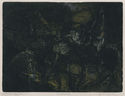
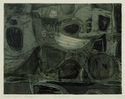
Father Mark Delery asked Margarete to create art for the vocational booklet, A Seeking of Perfect Love, for St. Joseph’s Abbey, a Trappist Abbey in Spencer, Massachusetts. As a printmaker, Margarete worked in etching, aquatint, and woodcut. Her art was taken on by Eleanor Hanegis, owner of the Retina Art Gallery in Harvard Square, Cambridge. After her death, the Portland Art Museum mounted a memorial exhibition of thirty-two of her prints.
Margarete Ann Walters was murdered and her body found in a Boston backyard on February 12, 1971. She had been carrying home many prints from the Retina Art Gallery and they became scattered across yards but eventually retrieved. Her sister spoke in favor of parole for the young man who killed her, arguing that Margarete would not have wanted him punished more but that he should have the education to understand what what he had done.