Pamela Boden Biography
Pamela Boden
British / American
1905–1981
Biography
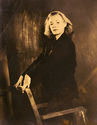
Pamela Antonia Boden, sculptor, designer, and draftsman, was born in Sherborn, Dorset, England on April 23, 1905. She was principally home-tutored except for one year at Heathfield Girls' School in Ascot, England. When she was seventeen, her family moved to Germany, where she studied music and art in Dresden and Munich. She also studied life drawing in Paris at the Académie de la Grande Chaumière.
In 1927, Boden moved to the South of France, where she began writing an irreverent novel, Persian Paradise. Her book was never published (in fact, it was politely rejected by T.S. Eliot for its content in 1936 when he worked for Faber & Faber, Ltd.), but her writing set the tone for the attitude and irreverence she displayed in her future work, whatever the medium. On October 8, 1930 she married Edmund Murray Kindersley in London, though it may have been a marriage of convenience as Boden was gay.
Boden soon returned to France where she began to associate with the avant-garde societies of Paris. Her circle soon included sculptors Hans (Jean) Arp and Ossip Zadkine; the painter Albert Gleizes; and the Portuguese writer and film maker Virginia de Castro e Almeida, with whom Boden later began a relationship. It was in Paris that she met the English composer Stanley Bate, who exposed her to the contemporary music scene and introduced her to the avant-garde Australian composer Peggy Glanville-Hicks. Boden would collaborate with both composers: with Bate as a set designer for his ballets, and much later with Glanville-Hicks for a sculpture exhibition accompanied by music. At some point around the mid 1930s Boden and Bate eloped for a brief marriage - likely as a joke as Bate was also openly gay (Bate would later marry Glanville-Hicks as a marriage of convenience).
At age twenty-seven, Boden began to carve decorative panels but soon turned to three-dimensional sculpture. In 1936, she exhibited at La Salon d’Automne with Albert Gleizes’s group and, in May 1938, she had a solo exhibition of her wood sculptures at Quatre Chemins in Paris.
In 1938, Pamela and Virginia moved for a time to Portugal, where Pamela illustrated a number of Virginia’s books and exhibited sculpture in Lisbon. Stanley Bate had joined the Arts Theatre group at the end of 1939 and revived his score for the ballet Perseus. He commissioned Boden to design the decor and costumes while Keith Lester provided the choreography and Harold (Hal) Turner danced the title role. Perseus was performed in London on 2 July 1940 at the Arts Theatre Club.
In November of 1940 Boden, Antonio Dacosta and Antonio Pedro organized the first Surrealist exhibition, titled EXPoem Esculture e Pintura at Casa Repe in Lisbon, Portugal, which was a key exhibition in Portugal for modernism. Boden exhibited six of her carved and assembled wooden sculptures. Around this time Boden, along with several of her friends, moved to the island of Ischia in Italy, where Boden continued to work until Virginia's death in 1945.
In 1950 Boden immigrated to New York. In February 1946, she exhibited in a two-person show titled 5 Sculptures / Pamela Bodin (sic) / Clyfford Still: First Exhibition - Paintings from February 12 to March 7 at Peggy Guggenheim’s Art of this Century at 30 West 57th Street. The show was held in one of the four exhibition spaces, the Daylight Gallery. Boden exhibited five sculptures carved from Portuguese “cyclone-felled cedar” which were placed in the center of the gallery, surrounded by Still’s paintings. The show was scheduled to run between February 12 and March 2 but, due to a city-wide strike, received little press coverage and was extended to March 7. Additionally, her name was misspelled in all of the marketing leading up to the show, and thus she was not provided the exposure an artist would otherwise have gained by exhibiting at Peggy Guggenheim’s gallery. Despite these setbacks, comments on Boden’s work were favorable, including that of art critic Emily Genauer who praised Boden’s work as “highly original, sharply rhythmic in their organization, and full of clean strength.” The Art News review appraised the work as having “considerable ingenuity” with their “sharp, deep cuts, leaving the coarse grain mostly unpolished, and often used knotholes.”
Wanting a change of scenery, Boden, who was drawn to high desert country, moved to Taos, New Mexico in 1946. During this period, she showed with La Galeria Escondida, operated by Eulalia Emertaz in Taos, New Mexico, which was also exhibiting work by Richard Diebenkorn, Ed Corbett, Bea Mandelman, Louis Ribak, Andrew Dasberg and other Modernist painters living in Taos. In 1948 she was in a group show at the New Mexico Museum of Art with Charles Reynolds, Joe D. Reed, Sven Gustafson, Stella Snead, and Ann Breese. In August of that year she was given an exhibition at Barbara Byrnes and Clara Grossman's American Contemporary Gallery, Los Angeles, for the exhibition "Introducing Fantastic Sculpture by Pamela Boden." This also debuted visionary filmmaker Elwood Decker's experimental, avant-garde abstract film, Color Fragments, which featured Pamela's sculpture.
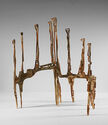
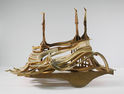
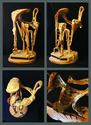
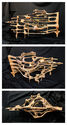
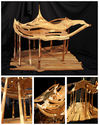
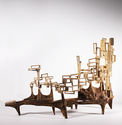
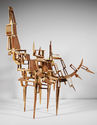
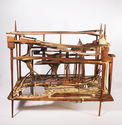
Boden moved further west in 1955, now to Los Angeles, where she showed at the Paul Rivas Gallery and her work was exhibited at the Los Angeles County Museum of Art. After three years, Boden made her final move to the San Francisco Bay Area, settling in Marin County. She perfected her sculpture technique, which had evolved into carefully cutting, shaping, and gluing together small pieces of wood into Surreal landscapes, birds and animals. Boden kept them unpainted, the only color being the wood and the “wood maché” mixture she learned from sculptor-friend Robert Cremean. The maché was made of glue, sawdust and modeling paste, used like plaster that she added to create and secure the forms. One of her sculptures was included in the San Francisco Art Association's 79th Annual Painting and Sculpture Exhibition, March - April of 1960, and in 1963 she was in two major exhibitions: the biennial exhibition American Contemporary Painting and Sculpture at the University of Illinois, Urbana; and in a group show at David Cole Gallery in San Francisco. The following year a solo exhibition of her sculpture opened in the spring at the Richmond Art Center. Further San Francisco exhibitions included the David Cole Gallery, the San Francisco Museum, Stanford University, and Ann O’Hanlon’s Sight and Insight Gallery.
In 1978, the Australian composer Peggy Glanville-Hicks, with the help of music critic James Murdoch, arranged for an exhibition of Boden’s sculpture in Sydney at the Australia Music Centre, Gallery A, between May 13 and June 3. Seven sculptures were selected and Glanville-Hicks contacted composer friends to write a musical score for each sculpture in the show. The exhibition consisted of the following works: 1) Girondelle for Giraffes: composition by Australian Peggy Glanville-Hicks; 2) Rocking Horse: composition by Australian Ross Edwards; 3) The Magician’s Castle: composition by Australian Don Banks; 4) Gambol: composition by Australian Peter Sculthorpe; Mountain Torrent: composition by American Lou Harrison; 6) Estuary: composition by Australian Vincent Plush; 7) Horses Fleeing: composition by Australian David Gulpilil. (David Gulpilil Ridjimiraril Dalaithngu was a skilled Aboriginal Australian dancer, tracker, hunter and musician who achieved an international reputation as an actor in the 1970 film Walkabout. Gulpilil composed his work on the didgeridoo.) During the exhibition, each sculpture was placed on a rotating base and a spotlight moved from one sculpture to another and as it stopped at a work the piece of music was played. The exhibition traveled on to the Tolarno Gallery in Melbourne.
Pamela Boden died in Inverness, California on August 1, 1981.
A variation of this biography appears with many illustrations in the book Emerging From the Shadows: A Survey of Women Artists Working in California 1860-1960 by Maurine St. Gaudens, volume I, 2015; ISBN978-0-7643-4861-7