
Chatiment des Servantes - Pl. XI from the "L'Odyssee" portfolio by Andre Masson
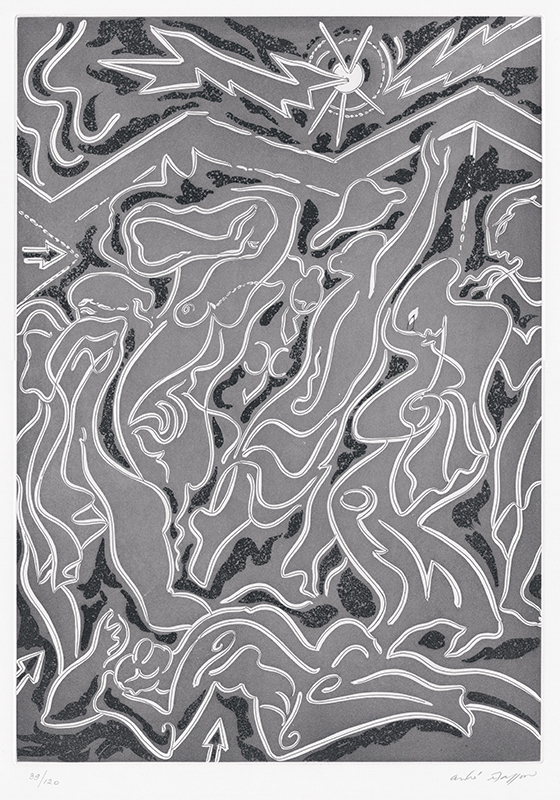
Chatiment des Servantes - Pl. XI from the "L'Odyssee" portfolio
Andre Masson
Title
Chatiment des Servantes - Pl. XI from the "L'Odyssee" portfolio
Artist
Andre Masson
1896 - 1987 (biography)Year
1977 /78
Technique
etching and color aquatint
Image Size
19 1/2 x 13 11/16" platemark
Signature
pencil, lower right
Edition Size
39 of 120
Annotations
pencil editioned, lower left
Reference
Cramer 111
Paper
cream Rives velin wove
State
published
Publisher
UNESCO
Inventory ID
JPR120
Price
$1,000.00
Description
Upon his return to Ithaca after a twenty-year absence, Odysseus made his way into his palace dressed as a swineherd. Within the palace he witnessed the suitors of Penelope eating and drinking that which was not theirs and abusing both physically and verbally the beggars, including himself. When Odysseus disclosed himself and challenged their right to what was before them, one suitor admitted that they had done much wrong on his land and in his house. With the aid of his son, Telemachus, and the swineherd, Odysseus slew the suitors. He then beckoned the nurse Euryclea and beseeched her to disclose the names of the maids that had lain with the suitors. Those twelve maids were commanded to clean up the death scene by removing the bodies and cleaning up the gore and blood. Odysseus told Telemachus and the swineherd to force the maids into a small space and kill them with their spears. In this image, Masson presents the maids packed tightly together against what appears to be a wall. Fluid, sinuous lines create the outlines of the maids and suggest their movement and panic as their "sins" have been exposed and they face their punishment. The arrows reference spears from which the maids run from, turn from, or drop from. The "L'Odysee" portfolio of twelve images was published by UNESCO (United Nations Educational, Scientific and Cultural Organization) and printed by the artist and Atelier Crommelnyck in an edition of 120 plus 20 artist's proofs. Andre Masson moved to Paris in 1912 to study at the École nationale supérieure des beaux-arts. While in Paris, he became interested in mythological-themed paintings of Nicolas Poussin, subjects that he would later investigate in his own work. In 1915 he joined the French infantry and fought in the battles of the Somme. He was seriously wounded during a battle in 1917 and spent months in the hospital recovering physically and psychologically. The war influenced Masson's art and he later wrote, "The field of battle made a human being of me. It literally threw me into the humus humain." In 1919, he moved to the south of France for a few years before returning to Paris. There he participated in the Surrealist movement between 1924 and 1929 and became a leading practitioner of automatism. Masson's work was declared degenerate under the German occupation of France during World War II. He fled France eventually taking refuge in United States, first living in New York before moving to rural Connecticut in 1941. It was during this time that he worked at Stanley William Hayter's experimental workshop Atelier 17 at the New School in New York. Masson returned to France in 1945 and settled in Aix-en-Provence in 1947. He was awarded the Grand Prix National des Art in 1954 and, in 1958, the Venice Biennale dedicated an entire room to his work. As early as 1933 he produced designs for the stage and, in 1965, he was invited to paint the ceiling of the Théâtre de l'Odéon in Paris. Andre Masson died on 28 October 28 1987 in Aix-en-Provence, France.