

Paul Wunderlich Biography
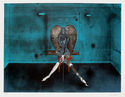


Paul Wunderlich
German
1927–2010
Biography
Painter, sculptor, and printmaker Paul Wunderlich was born in Eberswalde, Germany, on March 10, 1927. Following his wartime conscription in the Flakhelfer (auxilary positions for high school students) during World War II, including time spent as a prisoner of war, he was able to complete his his high school studies around 1945. After visiting the Palace School of Art at the Oangery of Eutin Castle, he decided to enroll in art classes at the Hamburg Academy in 1947. There, he studied printmaking under William Tietze.
After a three year hiatus to travel abroad in France and elsewhere, he returned to the Academy to continue his studies under Willam Grimm. Follwing graduation in 1951, he continued on as a lecturer and a professor of printmaking. At the same time, he worked as the master printer for Emil Nolde's etching "The King and His Men" and for Oskar Kokoschka's suite of lithographs, "Ann Eliza Reed." In 1955, he was awarded a scholarship from the Cultural Committee of German Industry.
His early work was in an modernist figurative style, but in the early 1960s he adopted a more Surrealist style, blending the aesthetics of Art Nouveau and Art Deco into his work. Much of his work explored the human figure and frequently despicted stylized, surreal nudes that in 1960 was the subject of censorship by the Hamburg city council. Despite this, his work proved successful and he received the Prize of the Youth award for his graphic art in 1961. He took these earnings and moved to France where, aside for a temporary return to teach in Hamburg from 1963 to 1968, he would live for the rest of his life.
He began developing his sculpture technique in the late 1960s, inspired by the work of Salvadore Dali. In 1971 he married photographer Karin Szekessy, with whom he would collaborate by painting or making fine prints of her work as seen through his style. Wunderlich would travel and exhibit throughout the world, including in New York, Switerland, and Belgium. He died in Saint-Pierre-de-Vassols, Provence on June 6, 2010.
Wunderlich held many major exhibitions world wide and won innumerable International prizes, particularly for his colour lithography. He was immensley prolific, leaving behind a vast oeuvre of prints, paintings in many media, sculpture, jewelry and furniture design. His renditions after classic paintings by artists such as Dürer, Ingres and Rembrandt show his inventiveness.